
Conexiant
Login
  • The Analytical Scientist
  • The Cannabis Scientist
  • The Medicine Maker
  • The Ophthalmologist
  • The Pathologist
  • The Traditional Scientist
The Analytical Scientist
  • Explore

    Explore

    • Latest
    • News & Research
    • Trends & Challenges
    • Keynote Interviews
    • Opinion & Personal Narratives
    • Product Profiles
    • App Notes
    • The Product Book

    Featured Topics

    • Mass Spectrometry
    • Chromatography
    • Spectroscopy

    Issues

    • Latest Issue
    • Archive
  • Topics

    Techniques & Tools

    • Mass Spectrometry
    • Chromatography
    • Spectroscopy
    • Microscopy
    • Sensors
    • Data and AI

    • View All Topics

    Applications & Fields

    • Clinical
    • Environmental
    • Food, Beverage & Agriculture
    • Pharma and Biopharma
    • Omics
    • Forensics
  • People & Profiles

    People & Profiles

    • Power List
    • Voices in the Community
    • Sitting Down With
    • Authors & Contributors
  • Business & Education

    Business & Education

    • Innovation
    • Business & Entrepreneurship
    • Career Pathways
  • Events
    • Live Events
    • Webinars
  • Multimedia
    • Video
    • Content Hubs
Subscribe
Subscribe

False

The Analytical Scientist / App Notes / 2014 / Analysis of the Vitamin B Complex in Infant Formula Samples

Analysis of the Vitamin B Complex in Infant Formula Samples

07/14/2014

Share

Featured Image
Overview

A rapid, robust, sensitive and specific LC-MS/MS assay using the AB SCIEX QTRAP® 6500 system has been developed for the simultaneous detection of all major forms of vitamin B complex. The method detects all currently used forms of vitamin B6 and vitamin B3 in infant formula and includes vitamin B12. The sample preparation allows the same extract to be used for Vitamin C detection and the LC-MS/MS conditions have been tuned so that the response for each vitamin is linear over the various required detection ranges.


ab-sciex-logo
08114-app-note-ab-sciex-Vitamin-main
Introduction

Vitamin B is a group of water-soluble vitamins that play important roles in cell metabolism. The absence of individual B vitamins in a diet can lead to several conditions including depression and high blood pressure so they are often added to foods, especially infant formula. Human daily nutritional recommendations for the members of the vitamin B complex vary considerably, for example from 6 μg of vitamin B12 to 20 mg of vitamin B3 (Table 1). The US Food and Drug Administration regulates food labels in the United States and food labeling is required for most prepared foods such as breads, cereals, canned foods, snacks, drinks, and especially for infant formula, which is highly regulated.1
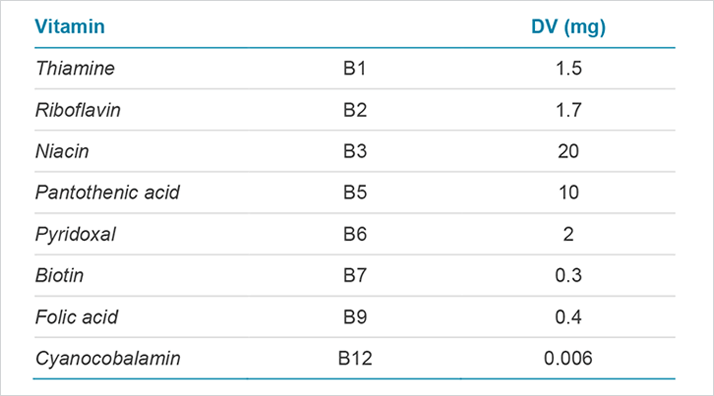
08114-app-note-ab-sciex-Vitamin-table1Table 1. Daily required values (DV) of different B vitamins for a human adult as obtained from the FDA1

Analysis of food samples can be challenging, as the matrices are complex and sensitive methods typically require highly selective sample clean up procedures. Vitamin B is a complex mixture of highly polar compounds (Figure 1) whose pKa range from 0.5 to 10.2, making their analysis challenging. Several methodologies exist to look at these analytes in separate classes, but relatively few analytical methods exist that examine the vitamin B complex as a whole, with high throughput capabilities, minimal sample preparation, and which have high sensitivity and specificity.Here we present new data acquired by Liquid Chromatography tandem Mass Spectrometry (LC-MS/MS) from a quantitative method that contains vitamins B1, B2, B3 (two forms), B5, B6 (three forms), B7, B12 and folic acid (vitamin B9).. Instrument detection levels for these vitamins using this method have been shown to be less than a ng/mL for the neat compounds using positive mode Electrospray Ionization (ESI) and the Scheduled MRM™ algorithm. The required limits of detection vary greatly between each vitamin, but all the B vitamins can be detected in infant formula, by adjusting the MS/MS voltages accordingly, even with detection limits having a 10,000-fold range. The LC-MS/MS method utilizes a small particle size polar endcapped reversed phase (RP) column and an 11 min gradient. In this new iteration of the method very little sample preparation has been used to enable a high throughput suitable for routine food testing.

>> Download the full Application Note as PDF

Newsletters

Receive the latest pathologist news, personalities, education, and career development – weekly to your inbox.

Newsletter Signup Image

Explore More in Pathology

Dive deeper into the world of pathology. Explore the latest articles, case studies, expert insights, and groundbreaking research.

False

Advertisement

Recommended

False

Related Content

Comprehensive Analysis of Drug Residues from a Confiscated Pipe

May 1, 2014

This application note shows the utility of high resolution mass spectrometry with soft ionization to facilitate identification of unknown compounds which were present in extracted residues from a confiscated pipe...

Extraction and Analysis of Neonicotinoid Pesticides from Flower Blossoms

May 6, 2014

In this application, the Quick, Easy, Cheap, Effective, Rugged, Safe (QuEChERS) approach was used to develop an extraction and cleanup method for the analysis of seven neonicotinoid pesticides in flower blossoms...

Ultrapure water: LC-MS suitability tests

May 7, 2014

Fresh ultrapure water used in all the experiments was produced from a Milli-Q® water purification system fed by an Elix system...

GC/MS analysis of a complex sample in DCM using hydrogen carrier gas

May 8, 2014

This application note aims to demonstrate the injection of a complex, 76-component sample diluted in Dichloromethane (DCM) using hydrogen carrier gas...

Thank you for reading The Analytical Scientist

To continue reading, either register for a free account below or login.

Register or Login

False

The Analytical Scientist
Subscribe

About

  • About Us
  • Work at Conexiant Europe
  • Terms and Conditions
  • Privacy Policy
  • Advertise With Us
  • Contact Us

Copyright © 2026 Texere Publishing Limited (trading as Conexiant), with registered number 08113419 whose registered office is at Booths No. 1, Booths Park, Chelford Road, Knutsford, England, WA16 8GS.