Goal
To accurately detect and quantitate organochlorinated pesticides in extracts from solid and liquid matrices using gas chromatography (GC) with an electron capture detector (ECD).
Introduction
Organochlorine insecticides are among the oldest and most toxic synthetic pesticides. First introduced in the 1940s, these chemicals were used extensively until most of them were banned in the 1970s and 1980s due to their health risks. Organochlorines are neurotoxic and some organochlorine compounds are suspected carcinogens.Organochlorines, such as DDT and lindane, also break down slowly once released. This persistence in the environment leads these organochlorines to be incorporated into ecosystems and food chains where they remain for years. For these reasons, the presence of these analytes in water, soils, and other solids must be strictly controlled and various analytical methods have been developed to extract and purify them from various matrixes. The presence of chlorine atoms in their structure makes organochlorines an excellent target for an electron capture detector (ECD)—a sensitive, cheaper, and easier-to-operate alternative to mass spectrometry. This application note describes a convenient method for analyzing and quantifying organochlorinated pesticides via GC and ECD.

Experimental Conditions
Sample Preparation Matrix extraction and purification are performed following U.S. Enivronmental Protection Agency Method 8081 guidelines.
Instrument Setup
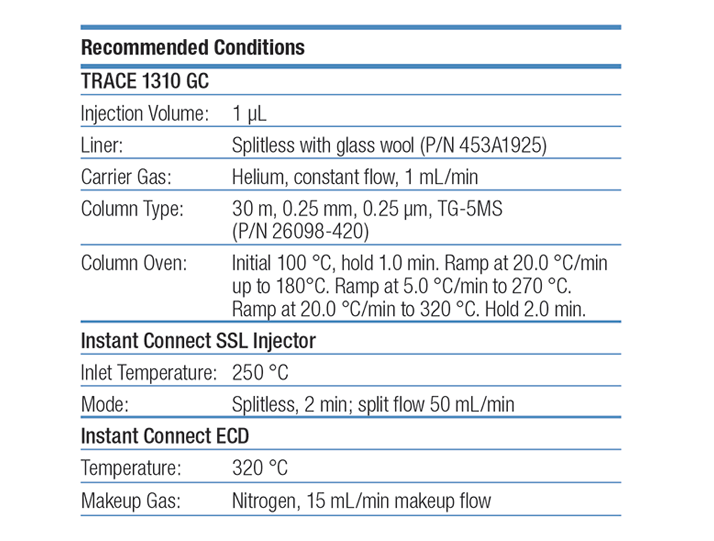
A method was developed for the Thermo Scientific™ TRACE™ 1310 Gas Chromatograph used with a Thermo Scientific™ TriPlus RSH™ Autosampler, an Instant Connect Split/Splitless (SSL) Injector and an Instant Connect Electron Capture Detector (ECD) for TRACE 1300 Series GC.
Method
The experimental method follows the guidelines for U.S. EPA method 8081, with slight modifications to the GC ramp and use of a column with 0.25 μm film thickness to guarantee better separation. The TriPlus RSH Auto-sampler is operated in liquid injection mode. All other parameters are those indicated by U.S. EPA Method 8081. Ethyl acetate is used as the solvent for washing the syringe. The standards used for calibration are ordered from Restek. All samples are acquired and processed using the Thermo Scientific™ Dionex™ Chromeleon™ 7.2 chromatography data system (CDS) software.
>> Download the full Application Note as PDF
Newsletters
Receive the latest pathologist news, personalities, education, and career development – weekly to your inbox.