Conexiant
Login
  • The Analytical Scientist
  • The Cannabis Scientist
  • The Medicine Maker
  • The Ophthalmologist
  • The Pathologist
  • The Traditional Scientist
The Analytical Scientist
  • Explore

    Explore

    • Latest
    • News & Research
    • Trends & Challenges
    • Keynote Interviews
    • Opinion & Personal Narratives
    • Product Profiles
    • App Notes
    • The Product Book

    Featured Topics

    • Mass Spectrometry
    • Chromatography
    • Spectroscopy

    Issues

    • Latest Issue
    • Archive
  • Topics

    Techniques & Tools

    • Mass Spectrometry
    • Chromatography
    • Spectroscopy
    • Microscopy
    • Sensors
    • Data and AI

    • View All Topics

    Applications & Fields

    • Clinical
    • Environmental
    • Food, Beverage & Agriculture
    • Pharma and Biopharma
    • Omics
    • Forensics
  • People & Profiles

    People & Profiles

    • Power List
    • Voices in the Community
    • Sitting Down With
    • Authors & Contributors
  • Business & Education

    Business & Education

    • Innovation
    • Business & Entrepreneurship
    • Career Pathways
  • Events
    • Live Events
    • Webinars
  • Multimedia
    • Video
    • Content Hubs
Subscribe
Subscribe

False

The Analytical Scientist / App Notes / 2014 / The Use of GCxGC-TOFMS and Classifications for the Quantitative Determination of Different Compound Classes

The Use of GCxGC-TOFMS and Classifications for the Quantitative Determination of Different Compound Classes

03/28/2014

Share

Featured Image
Introduction

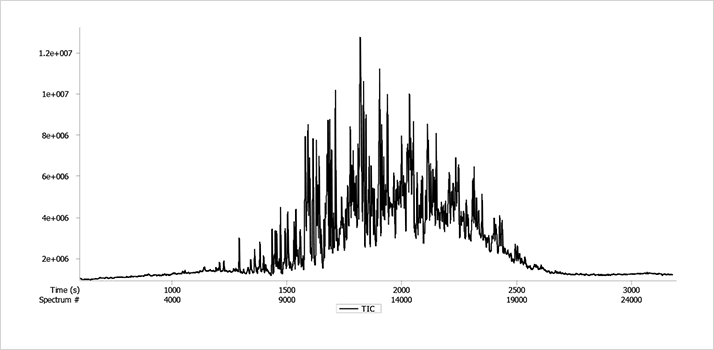
One of the important challenges facing hydrocarbon analysts is the accurate determination of the amounts of different classes of compounds in complex samples. For example a typical aliphatic hydrocarbon sample may contain linear hydrocarbons ranging over twenty or more carbon numbers, as well as a plethora of branched and cyclic hydrocarbon isomers over a similar range of carbon numbers. One dimensional gas chromatographic (GC) analysis is inadequate for this task, even when using long specialized columns, and Time-of-Flight Mass
Spectrometry (TOFMS), as can be seen in Figure 1.

new leco logo
app note-014-037 leco fig1Figure 1. GC-TOFMS Analysis of the Complex Aliphatic Hydrocarbon Sample 1.
The sample complexity precludes accurate assessment of all the different classes of hydrocarbon components, even when using advanced techniques such as GC-TOFMS and the powerful deconvolution algorithm available through the ChromaTOF® software package. Comprehensive two-dimensional gas chromatography (GCxGC) coupled to Time-of-Flight mass spectrometry (TOFMS) can play a significant role in handling samples where complexity is a key issue. The increased peak capacity of GCxGC, coupled with the powerful deconvolution software available in the ChromaTOF software package used to operate LECO Pegasus® and TruTOF®
systems, allows the co-elution always present in complex hydrocarbon samples to be minimized. Where it does occur, the software handles this in such a way that compound identification and quantitation are not compromised. In addition, the Classification feature provides a powerful tool for differentiation and quantitation of compound classes.

Experimental Conditions

Samples Two samples (1 and 2) were used for analysis which contained linear, branched and cyclic alkanes over a significant range of carbon numbers. No aromatic components were present in the samples. Both samples contained over 1000 components. Analysis Conditions The correct choice of columns is a prerequisite for successful GCxGC analysis of complex hydrocarbon samples. The column set should provide good separation of all the components, it should be thermally robust with the ability to handle the elevated temperatures needed for successful chromatography of the less volatile components, and it should make good use of the total chromatographic space of the analysis. This is of particular importance in the samples used in this analysis. Because of the sample complexity and the extremely large number of branched and cyclic hydrocarbons present in the samples it was found that the customary "non-polar" – "polar" column combination did not provide suitable component separation. The final column set used and the conditions for the analyses are shown in Table 1.
>> Download the full Application Note as PDF

Newsletters

Receive the latest pathologist news, personalities, education, and career development – weekly to your inbox.

Newsletter Signup Image

Explore More in Pathology

Dive deeper into the world of pathology. Explore the latest articles, case studies, expert insights, and groundbreaking research.

False

Advertisement

Recommended

False

Related Content

Comprehensive Analysis of Drug Residues from a Confiscated Pipe

May 1, 2014

This application note shows the utility of high resolution mass spectrometry with soft ionization to facilitate identification of unknown compounds which were present in extracted residues from a confiscated pipe...

Extraction and Analysis of Neonicotinoid Pesticides from Flower Blossoms

May 6, 2014

In this application, the Quick, Easy, Cheap, Effective, Rugged, Safe (QuEChERS) approach was used to develop an extraction and cleanup method for the analysis of seven neonicotinoid pesticides in flower blossoms...

Ultrapure water: LC-MS suitability tests

May 7, 2014

Fresh ultrapure water used in all the experiments was produced from a Milli-Q® water purification system fed by an Elix system...

GC/MS analysis of a complex sample in DCM using hydrogen carrier gas

May 8, 2014

This application note aims to demonstrate the injection of a complex, 76-component sample diluted in Dichloromethane (DCM) using hydrogen carrier gas...

Thank you for reading The Analytical Scientist

To continue reading, either register for a free account below or login.

Register or Login

False

The Analytical Scientist
Subscribe

About

  • About Us
  • Work at Conexiant Europe
  • Terms and Conditions
  • Privacy Policy
  • Advertise With Us
  • Contact Us

Copyright © 2025 Texere Publishing Limited (trading as Conexiant), with registered number 08113419 whose registered office is at Booths No. 1, Booths Park, Chelford Road, Knutsford, England, WA16 8GS.