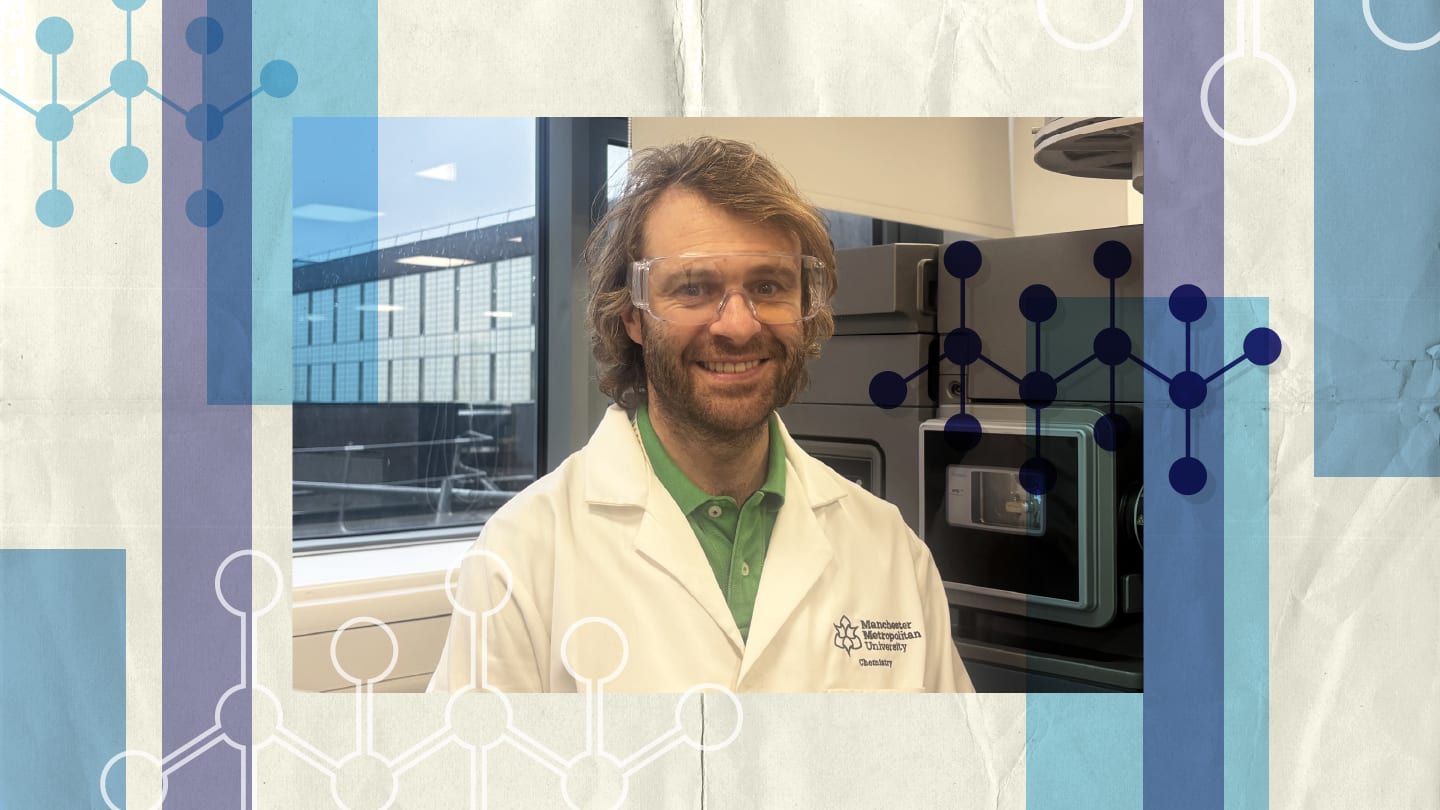
David Megson first got involved with PFAS when he was working in North America as a postdoc. He realized that they were about eight to ten years ahead of where his native UK was. “They’d already recognized it as a major problem and were actively trying to tackle it – there was a real surge in developing analytical techniques,” he says.
When he came back to the UK around 10 years ago, he was surprised by how big the gap was. “There just wasn’t the same level of awareness or urgency. I went from a place where PFAS were treated as a top priority to somewhere they were barely on the radar.”
This led Megson, now Associate Professor of Environmental Chemistry at Manchester Metropolitan University, UK, to focus on raising the profile of PFAS in the UK – through media outreach and also by supporting people from within the community and helping them upskill. He helped to organize a series of network meetings and open “ask me anything” sessions with experts, to build understanding and spark dialogue. “That really helped people start to get their heads around how we could regulate and manage PFAS more effectively here in the UK,” he says.
Since then, and largely due to coverage in the media, PFAS has become a key priority for government agencies. “It can feel like an article comes out highlighting a specific issue, and suddenly the relevant agencies jump into action,” says Megson. “For example, when there was coverage about PFAS in Cambridgeshire drinking water, the UK Drinking Water Inspectorate (DWI) quickly mobilized, putting in resources and coming up with new guidance for water. Then another story might focus on food, and suddenly the Food Standards Agency, Fera, and DEFRA are responding with their own guidance – often with different PFAS targets and methods. I know these agencies are constantly working and reviewing guidance on this complex evolving issue, but hopefully the media pieces have provided them with justification and support to do the work they want to do”
The result, however, is a fractured regulatory landscape. “Depending on what you’re sampling, everyone is looking for different PFAS, using different lists, different methods, and different priorities.”
He believes the time is right for the UK – and for governments around the world – to take a more joined-up approach – to align how we assess risk, monitor contamination, and conduct routine testing. “Research shows that even if you’re measuring PFAS A, B, C, and D, there are thousands of others out there. So we have to ask: are we even looking at the right ones? Are we collecting the right data to truly understand the risk to people and the environment?”
Here, in the fourth installment of our PFAS: New Frontiers, Emerging Solutions series, David Megson, Associate Professor of Environmental Chemistry at Manchester Metropolitan University, UK, reflects on the fractured state of PFAS regulation, the rise of “regrettable substitutions,” and how analytical chemistry can help build the evidence base for meaningful reform.
The Story So Far
Chapter One: The Next Chapter of the PFAS Story – with Chris Higgins
Chapter Two: PFAS Enters its Big Data Era – with Jennifer Field
Chapter Three: The Biology of Forever – with Carrie McDonough
With so many PFAS – estimates range from thousands to millions – and only a small number clearly linked to toxicity, how are regulators even beginning to navigate that landscape?
Honestly, they must be tearing their hair out. There was a paper by Buck et al., in 2021, that listed 256 commercially relevant PFAS. Then the OECD came out with about 4,700. The US EPA databases now list over 10,000. And then there’s the Szymanski et al 2023 paper suggesting there could be up to seven million potential PFAS if you include anything with CF₂ or CF₃ groups. So how on earth do you regulate that? It’s a nightmare.
Within our lab we’ve been trying to chip away at the problem by asking: within this entire theoretical universe of PFAS, which ones are actually turning up in the environment when we do non-targeted analysis? And so far, we’ve found thousands. We identified 382 unique structural classes – which probably corresponds to about 3,000 to 4,000 individual PFAS that have actually been detected in the environment.
But, as you said, that’s only half the challenge. Yes, we can detect them – but their toxicities vary enormously. And assessing toxicity properly requires a huge number of different tests across different endpoints. The most reliable data often comes from animal studies, which are expensive, time-consuming, and ethically complicated. So there’s massive uncertainty on that side as well.
At the moment, there are two polarized schools of thought. One says: the carbon-fluorine bond is so strong that these chemicals will persist for decades. We can’t test them all, so let’s take a conservative approach – assume they’re risky until proven otherwise. The other – currently used approach, which is more favorable to PFAS manufacturers and users – argues: we don’t have the data to prove they’re toxic and persistent, so it’s fine to keep using them until evidence shows us otherwise.
As we slowly identify that an individual PFAS poses a significant risk we are now starting to see a “regrettable substitution” cycle: one PFAS is used widely, and over ten or fifteen years, enough evidence builds up to show it’s persistent and toxic, so it gets banned. Industry then switches to a slightly more degradable replacement – but that just breaks down into two new PFAS, both persistent and toxic. Then we ban those and move to the next ones.
It’s a repeating ten-year loop of replacing one harmful compound with another. That’s why what’s happening in Europe is so interesting – they’re trying to take the more conservative approach of banning all PFAS as a single class. It’s a huge shift, and it really highlights just how differently the problem is being approached around the world.
PFAS are incredibly useful materials, often without clear replacements. How do you think we should balance the benefits with the risks?
For the public, the perception tends to be that “chemicals are bad” – when in reality, we’re made of chemicals, we drink chemicals, and they’re essential to modern life. PFAS have a terrible reputation at the moment, but the truth is, they’re an extraordinary group of chemicals. They have so many valuable properties; that’s why they became so widespread in the first place.
The issue isn’t the chemistry itself – it’s how we’ve used these substances: irresponsibly, without adequate controls, and without any kind of circular economy. I genuinely think there’s a version of the world where PFAS can coexist with us – if we use them far more responsibly, and only in essential applications.
But right now, they’re used in countless products where they’re not needed, and often where safer alternatives already exist.
If you were advising someone in industry, what would you tell them about the next five years of PFAS regulation and testing?
If it’s a marginal call – and you’ve got the option to move away from PFAS – take it. Get out of PFAS.
I remember going to a Royal Society of Chemistry meeting of the Fluorine Interest Group. It was full of people who work with fluorine to produce useful chemicals for our everyday lives, so I felt like the awkward voice in the room saying, “This is really bad.” A lot of them said, “Well, we use CF₃ because it works well – it’s what we’ve always done.”
But when you actually look at the data, in many cases it may be possible to replace CF₃ with a single fluorine atom and it performs just as well. It’s often just habit that’s keeping people tied to CF₃ chemistry. So there’s definitely scope for companies to make changes.
Of course, in the pharmaceutical world, it’s much harder. If a drug is already on the market, you can’t just swap out a CF₃ for an F without revalidating the whole drug – which is hugely expensive, time-consuming, and comes with no guarantee it’ll work the same way. But going forward, whenever there’s a marginal design decision, my advice would be: get rid of the CF₃ and CF₂ groups. Focus on PFAS alternatives.
And I think that’s where government funding could really help – to drive the R&D needed to develop those alternatives. It’s a great opportunity for industry and academia to work together. With just a bit of targeted support, everyone could win.
What promising analytical approaches are emerging right now?
Several, actually. There’s a lot of exciting work happening in this space.
One is combustion ion chromatography, where you essentially roast the sample to break down all the compounds, release the fluorine, and then measure the fluoride ions. If you subtract the inorganic fluorine naturally present in the sample, you get a solid worst-case estimate of “total fluorine.”
Another is the TOP assay – the Total Oxidizable Precursor method – which chemically converts PFAS into their most stable (and often most toxic) forms. From a risk-assessment point of view, that’s really useful because it captures the nastier PFAS within one total number.
So we now have a few “total” approaches that can be used alongside targeted ones. The framework I’ve been advocating for is simple. First, do your targeted analysis on the 40 or so PFAS we routinely measure. At the same time, run one of the total methods on one composite sample – it doesn’t matter which, just pick one and start using it. Then compare your results.
If your targeted total PFAS matches the total fluorine number – great, your targeted method is capturing the key compounds. But if there’s a big gap between the two, that’s your signal to bring in non-targeted analysis using high-resolution mass spectrometry to identify what’s missing. Once you’ve found those new compounds, you can add them into your targeted screen.
Non-targeted work is too expensive and complex to do routinely on every single sample, but as a check – to make sure we’re not overlooking important PFAS – it’s incredibly valuable.
Who needs to be driving that change – the labs doing the analysis or the companies commissioning it?
I think the key point is that labs respond to what their customers ask for – so ultimately, it has to come from the customers.
The labs have already shown what they can do when there’s a clear demand. When the UK DWI suddenly said, “we now need to start testing for these 47 PFAS,” they rose to the challenge. Chemically, those PFAS are very different from each other, so developing a single validated method that could cover that entire range was technically tough – but they nailed it in less than a year. That was seriously impressive.
Now we’re starting to see more “total” methods coming into use, and even some labs beginning to offer non-targeted analysis. The tools are there – they exist in academia and are starting to move into the commercial lab space – but only if customers demand them.
What we need is a bit of a regulatory nudge and more awareness, so people know these techniques exist and start asking for them. The only catch is: if you do find a brand-new PFAS at high concentrations, what does that actually mean? We often don’t have the toxicological data to say whether it’s a problem. So understandably, some people hesitate to look for things they’re not sure how to interpret.
That’s why we need toxicologists and chemists working hand in hand. The toxicologists are brilliant – they can do this – it’s just about connecting all the right people so we can finally start solving the problem together.
Are there any efforts to connect detection and toxicology data in a more coordinated way?
It’d be lovely, wouldn’t it? But I haven’t really seen much happening yet in the UK. There was a NERC call – that’s the UK’s Natural Environment Research Council – specifically focused on PFAS, but the funding was tiny, nowhere near enough to scratch the surface of such a huge challenge.
To do it properly, we’d need real investment and a joined-up approach: something where industry contributes funding, labs and academia match-fund, and government acts as the central coordinator to pull it all together. It’s not impossible – the expertise is out there – but it needs that initial, coordinated push to get off the ground.
It’s easy from the outside to paint “big industry” as the villain, but I like to think most people working in those roles don’t want to poison the world. They do want to find safer alternatives and protect people – and when I’ve spoken to them, that’s genuinely the sense I get. They’re actively investigating replacements.
But at the end of the day, if the regulations say, “You can do this,” and the person making that final call is driven by profit, there’s really only one direction things will go – until the rules change. That’s why we need both: a stronger stick of regulation to enforce change, and a carrot to encourage the development of safer alternatives. That’s how we move things forward most effectively.
Looking ahead, what’s the key to improving our understanding and management of PFAS contamination?
I think the main point concerns the power of non-targeted analysis. What we’re finding is that targeted analysis is starting to let us down. It’s great for capturing the general background of PFAS, so it’s useful when there isn’t a major issue – but PFAS contamination is actually very source-specific.
We’ve been doing quite a bit of environmental forensics work to pin down techniques for identifying PFAS sources in the UK, and that’s been incredibly powerful. Using non-targeted methods, we can detect PFAS that are unique to certain processes or manufacturers. We can also use the chemical “fingerprint” – looking at the relative ratios of individual PFAS within classes, and within the overall profile – to trace contamination back to its source.
So we now have some really strong analytical tools to help untangle this complex issue. We can identify key sources and estimate their contribution to environmental PFAS levels. Where we’re still falling short is on the joined-up regulation and the toxicological testing needed to prove whether those chemicals – individually and, crucially, as mixtures – are causing harm. That’s where the real challenge lies.
Finally, what’s your key message to readers about the path forward?
I think it’s important to stress that we already have excellent analytical tools to monitor PFAS effectively. Once the regulation catches up – and it will – the science is ready to support it. The techniques exist to help us measure, manage, and ultimately make better decisions about PFAS. It’s just about joining the dots between policy, toxicology, and analysis to actually make it happen.
The Story Continues
Chapter Five: Portable Sensors: The Next Generation of PFAS Detection – Silvana Andreescu
Newsletters
Receive the latest analytical science news, personalities, education, and career development – weekly to your inbox.