Conexiant
Login
  • The Analytical Scientist
  • The Cannabis Scientist
  • The Medicine Maker
  • The Ophthalmologist
  • The Pathologist
  • The Traditional Scientist
The Analytical Scientist
  • Explore

    Explore

    • Latest
    • News & Research
    • Trends & Challenges
    • Keynote Interviews
    • Opinion & Personal Narratives
    • Product Profiles
    • App Notes
    • The Product Book

    Featured Topics

    • Mass Spectrometry
    • Chromatography
    • Spectroscopy

    Issues

    • Latest Issue
    • Archive
  • Topics

    Techniques & Tools

    • Mass Spectrometry
    • Chromatography
    • Spectroscopy
    • Microscopy
    • Sensors
    • Data and AI

    • View All Topics

    Applications & Fields

    • Clinical
    • Environmental
    • Food, Beverage & Agriculture
    • Pharma and Biopharma
    • Omics
    • Forensics
  • People & Profiles

    People & Profiles

    • Power List
    • Voices in the Community
    • Sitting Down With
    • Authors & Contributors
  • Business & Education

    Business & Education

    • Innovation
    • Business & Entrepreneurship
    • Career Pathways
  • Events
    • Live Events
    • Webinars
  • Multimedia
    • Video
    • Content Hubs
Subscribe
Subscribe

False

The Analytical Scientist / Issues / 2026 / February / How Manufacturing Changes Battery Microstructure
Spectroscopy Materials Science News and Research

How Manufacturing Changes Battery Microstructure

A dual-labeling strategy links binder microstructure to processing choices and electrode performance

02/27/2026 1 min read

Share

Credit: Stanislaw Zankowski

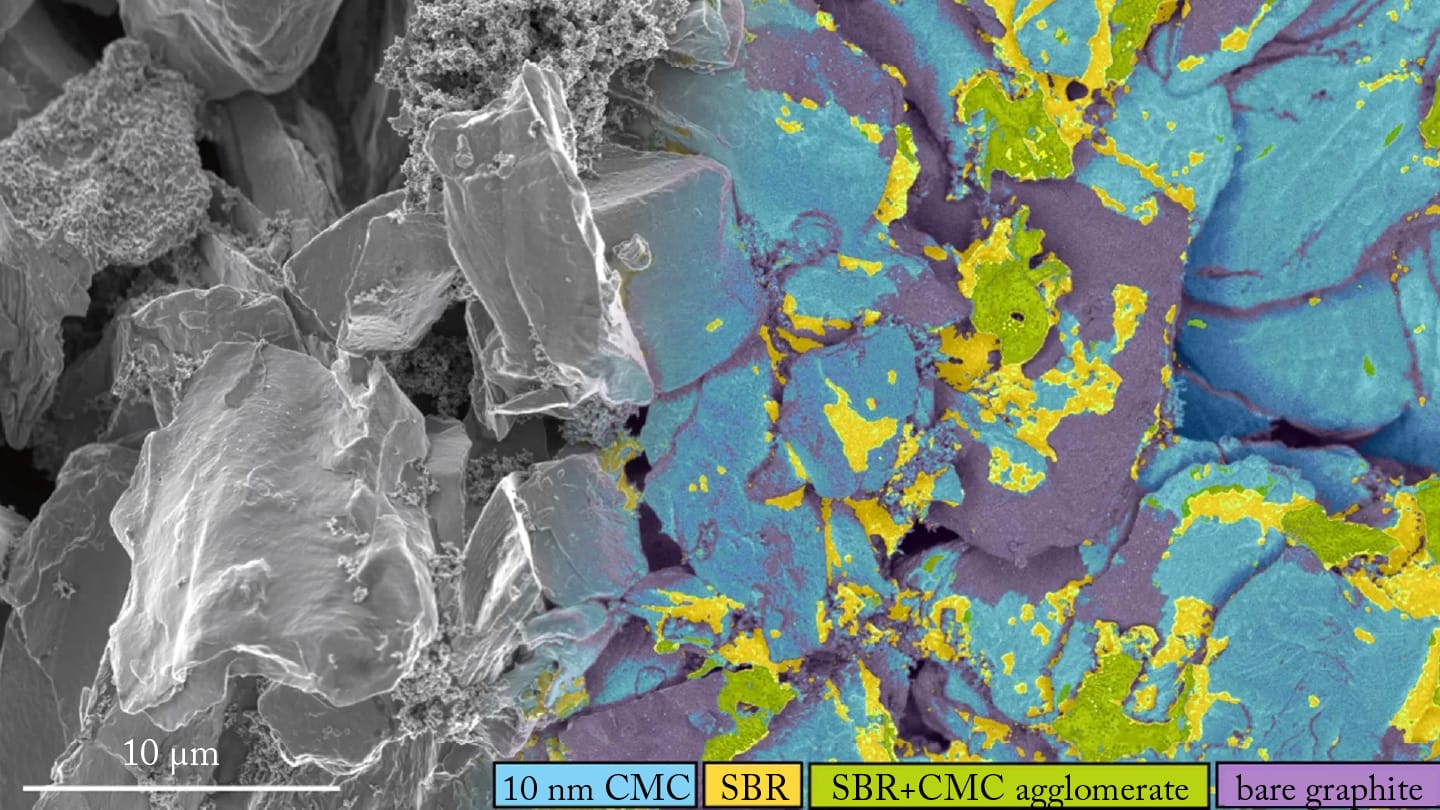
A chemical staining approach developed at the University of Oxford enables polymer binders in lithium-ion battery anodes to be mapped at the nanoscale, revealing structural features that have previously been difficult to resolve.

The work focuses on the widely used carboxymethyl cellulose (CMC) and styrene-butadiene rubber (SBR) binder system employed in graphite and graphite-silicon anodes. Because these polymers lack distinctive elemental signatures, their distribution has largely been inferred indirectly – limiting efforts to optimize manufacturing processes.

To overcome this, the team developed two complementary staining approaches. Silver ions were used to selectively bind carboxyl groups in CMC, while bromine vapor was used to label the unsaturated carbon bonds in SBR. Once stained, the binders could be mapped using standard electron microscopy techniques, including energy-dispersive X-ray spectroscopy and energy-selective backscattered electron imaging. This enabled binder domains to be resolved across length scales ranging from nanometers to hundreds of micrometers.

Applying the method to laboratory-made and commercial electrodes revealed previously inaccessible structural detail. In pristine graphite anodes, CMC formed continuous surface films as thin as 10–15 nm, while SBR appeared as discrete nanoparticle agglomerates. After calendering, however, these CMC layers fractured and delaminated, leaving large regions of bare graphite exposed. Similar disrupted binder morphologies were observed in commercial electrodes, suggesting that such effects are not confined to laboratory processing.

The staining tools also enabled binder-informed manufacturing optimization. By modifying slurry mixing protocols to reduce conductive carbon-binder agglomeration, the researchers achieved a 14 percent reduction in electronic resistivity. In a separate experiment, phase-inversion processing was used to control binder migration during high-temperature drying, reducing electrode ionic resistance by approximately 40 percent without altering composition or porosity.

The authors argue that making binder distribution directly visible provides a practical route to understanding how subtle processing choices influence electrode performance. They suggest that the approach could support off-line quality control and process optimization for both current lithium-ion batteries and emerging anode architectures.

Newsletters

Receive the latest analytical science news, personalities, education, and career development – weekly to your inbox.

Newsletter Signup Image

False

Advertisement

Recommended

False

Related Content

The Analytical Scientist Innovation Awards 2024: #3
Spectroscopy
The Analytical Scientist Innovation Awards 2024: #3

December 6, 2024

4 min read

Bruker’s multiphoton microscopy module, OptoVolt, ranks third in our Innovation Awards. Here, Jimmy Fong, product development lead, walks us through the major moments during development.

More Bang for Your Buck
Spectroscopy
More Bang for Your Buck

December 4, 2024

1 min read

Researchers develop more stable catalysts for dry reforming of methane – a promising method for carbon capture and utilization (CCU)

The Analytical Scientist Innovation Awards 2024: #1
Spectroscopy
The Analytical Scientist Innovation Awards 2024: #1

December 10, 2024

2 min read

And the technology ranked first in our 2024 Innovation Awards is…

The Analytical Scientist Innovation Awards 2024
Spectroscopy
The Analytical Scientist Innovation Awards 2024

December 11, 2024

10 min read

Meet the products – and the experts – defining analytical innovation in 2024

False

The Analytical Scientist
Subscribe

About

  • About Us
  • Work at Conexiant Europe
  • Terms and Conditions
  • Privacy Policy
  • Advertise With Us
  • Contact Us

Copyright © 2026 Texere Publishing Limited (trading as Conexiant), with registered number 08113419 whose registered office is at Booths No. 1, Booths Park, Chelford Road, Knutsford, England, WA16 8GS.