Conexiant
Login
  • The Analytical Scientist
  • The Cannabis Scientist
  • The Medicine Maker
  • The Ophthalmologist
  • The Pathologist
  • The Traditional Scientist
The Analytical Scientist
  • Explore

    Explore

    • Latest
    • News & Research
    • Trends & Challenges
    • Keynote Interviews
    • Opinion & Personal Narratives
    • Product Profiles
    • App Notes
    • The Product Book

    Featured Topics

    • Mass Spectrometry
    • Chromatography
    • Spectroscopy

    Issues

    • Latest Issue
    • Archive
  • Topics

    Techniques & Tools

    • Mass Spectrometry
    • Chromatography
    • Spectroscopy
    • Microscopy
    • Sensors
    • Data and AI

    • View All Topics

    Applications & Fields

    • Clinical
    • Environmental
    • Food, Beverage & Agriculture
    • Pharma and Biopharma
    • Omics
    • Forensics
  • People & Profiles

    People & Profiles

    • Power List
    • Voices in the Community
    • Sitting Down With
    • Authors & Contributors
  • Business & Education

    Business & Education

    • Innovation
    • Business & Entrepreneurship
    • Career Pathways
  • Events
    • Live Events
    • Webinars
  • Multimedia
    • Video
    • Content Hubs
Subscribe
Subscribe

False

The Analytical Scientist / Issues / 2026 / February / Raman Tool Opens the Door to Continuous Vaccine Manufacturing
Pharma and Biopharma Pharma and Biopharma News and Research

Raman Tool Opens the Door to Continuous Vaccine Manufacturing 

A confocal Raman microscope-based tool can characterize viral particles at-line and in real time

By James Strachan 02/02/2026 2 min read

Share

The COVID-19 pandemic demonstrated the need for ways to rapidly deploy new vaccines at scale. However, a major bottleneck in current vaccine manufacturing processes is a lack of continuous monitoring of viral particles. Samples must be removed from the production line at the end of each cycle and transferred to an instrument for testing – a time-consuming step.

That’s why researchers at Purdue University, USA, and Merck & Co, developed a Raman spectroscopy-based tool to monitor viral particles in real time – and in flow conditions. Each test takes no longer than 30 seconds and leaves the viral particles undamaged.

“The study aims to reduce the time spent on quality control and enable rapid control of the process in case deviations are detected,” says Mohit S. Verma, associate professor of agricultural and biological engineering at Purdue, who led the research.

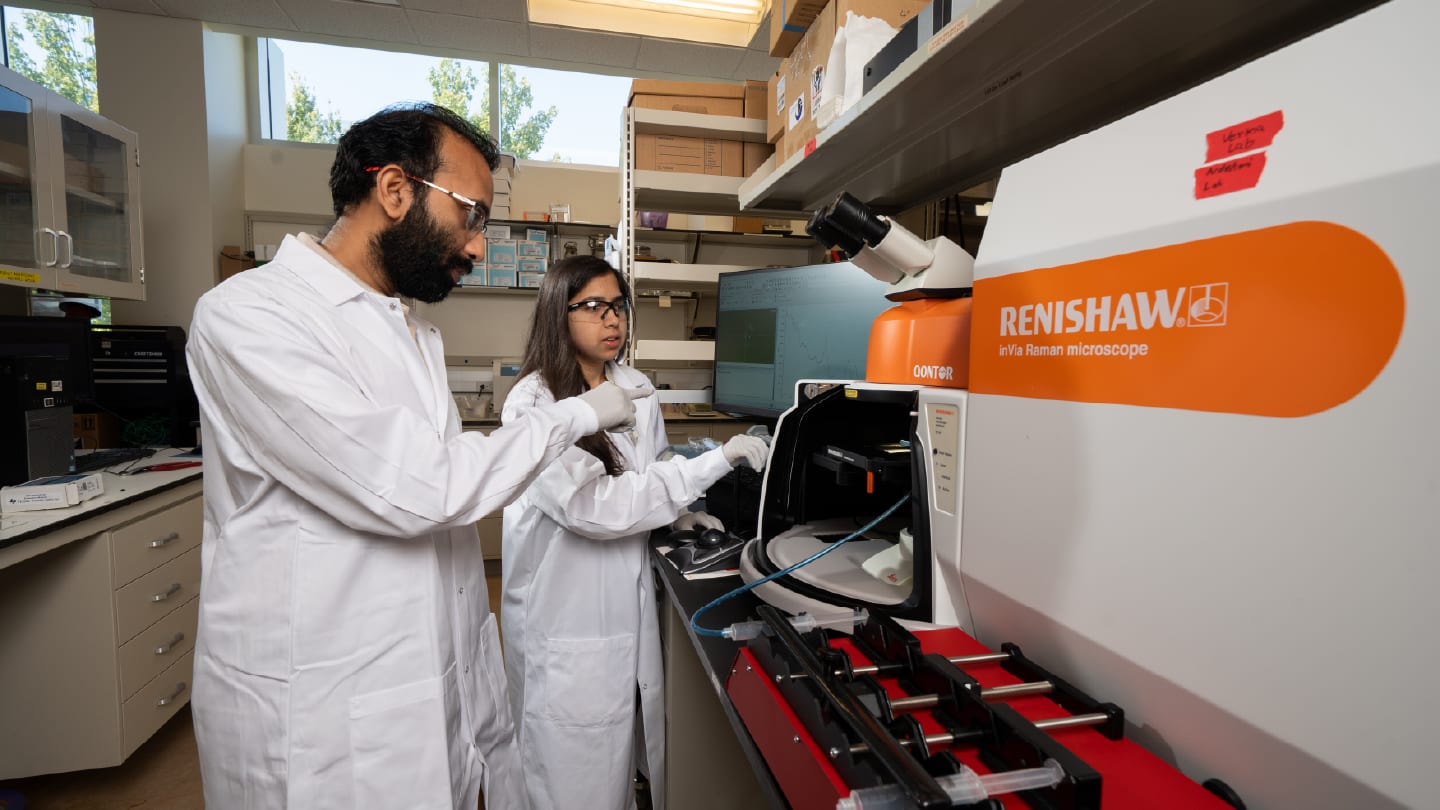
To study viral particles in flow conditions, the team designed a capillary device attached to a syringe pump. A confocal Raman microscope then captures Raman scattering from the sample after its exposure to the laser, providing a Raman spectrum specific to the sample.

The team’s initial experiments captured the Raman spectra of the sample containing both viral particles and the buffer, which contains excipients that serve as a background. The team then subtracted buffer spectra from the sample and used the processed spectra to detect and quantify viral particles. “There were multiple regions of the spectra that were specific to the viral particles and we used those for analysis,” says lead author and graduate student Shreya Athalye.

“This type of in-line analytical tool can be well integrated with continuous manufacturing processes, facilitating the monitoring of viral particles or other biologics as they are produced,” says Verma. “It will help capture defects in products and processes early on, saving a lot of time and money. It will also improve the product's yield and quality.”

The next step for the team is to explore the potential of portable Raman systems as an in-line tool for monitoring viral particles. “Portable Raman probes can be integrated into commercial manufacturing lines, providing valuable insights into the application of this technology,” says Verma. The main challenges include improving the limit of detection for the application in the early stages of the production cycle and in more complex media.

Newsletters

Receive the latest analytical science news, personalities, education, and career development – weekly to your inbox.

Newsletter Signup Image

About the Author(s)

James Strachan

Over the course of my Biomedical Sciences degree it dawned on me that my goal of becoming a scientist didn’t quite mesh with my lack of affinity for lab work. Thinking on my decision to pursue biology rather than English at age 15 – despite an aptitude for the latter – I realized that science writing was a way to combine what I loved with what I was good at. From there I set out to gather as much freelancing experience as I could, spending 2 years developing scientific content for International Innovation, before completing an MSc in Science Communication. After gaining invaluable experience in supporting the communications efforts of CERN and IN-PART, I joined Texere – where I am focused on producing consistently engaging, cutting-edge and innovative content for our specialist audiences around the world.

More Articles by James Strachan

False

Advertisement

Recommended

False

Related Content

Loading the Molecular Dice
Pharma and Biopharma
Loading the Molecular Dice

December 12, 2024

2 min read

How a framework for controlling molecular reactions at the atomic scale has potential implications for nanotechnology, pharmaceutical synthesis, and clean energy research

CD-MS: To Megadalton and Beyond
Pharma and Biopharma
CD-MS: To Megadalton and Beyond

October 1, 2024

10 min read

Charge-detection mass spectrometry (CD-MS) has extended the range of MS to gigadalton-sized viruses and polymers; and with a commercial instrument in development and exciting new applications in complex protein mixtures, maturity beckons

New NMR Technique Enables Direct Detection of Molecular Chirality
Pharma and Biopharma
New NMR Technique Enables Direct Detection of Molecular Chirality

October 1, 2024

1 min read

Researchers develop an NMR method to distinguish between enantiomers without the need for chiral agents

Mass Spec Imaging Meets Proteomics
Pharma and Biopharma
Mass Spec Imaging Meets Proteomics

October 2, 2024

2 min read

Researchers combine tissue imaging with proteomics to shed light on the neurotoxic effects associated with HIV medication Efavirenz treatment

False

The Analytical Scientist
Subscribe

About

  • About Us
  • Work at Conexiant Europe
  • Terms and Conditions
  • Privacy Policy
  • Advertise With Us
  • Contact Us

Copyright © 2026 Texere Publishing Limited (trading as Conexiant), with registered number 08113419 whose registered office is at Booths No. 1, Booths Park, Chelford Road, Knutsford, England, WA16 8GS.