Sulfur-containing biomolecules play essential roles in modern metabolism, yet their availability prior to the emergence of life has remained an open question in prebiotic chemistry. Experimental efforts to generate such compounds abiotically have often relied on localized or highly specific conditions, leaving uncertainty about their broader planetary relevance.
In a recent study, a team of researchers at the University of Colorado Boulder, USA, examined whether atmospheric chemistry on the early Earth could have acted as a globally distributed source of organosulfur molecules. Using laboratory simulations of Archean atmospheric conditions combined with high-resolution mass spectrometry, the team identified a diverse suite of sulfur-containing compounds formed under mild, scalable conditions.
In this interview, we speak with three co-authors of the study – Nate Reed, Ellie Browne, and Shawn McGlynn – about the analytical strategies behind the work, the challenges of detecting trace organosulfur species, and how atmospheric chemistry may intersect with emerging models of early biochemical evolution.
What initially motivated your team to explore Earth’s early atmosphere?
Browne: From studies of the modern Earth’s atmosphere, we know that organosulfur compounds are abundant and are formed via abiotic processes. However, most previous studies of planetary atmospheres had yet to explore organosulfur chemistry. In our initial work, we showed that we could form significant amounts of organosulfur compounds (Reed et al 2020, 2022). However, that work was focused on bulk identification and therefore lacked molecular detail. Naturally, we then turned our attention to understanding the specific types of organosulfur molecules that were forming.
Reed: In our previous work, we observed organosulfur molecules as products of this chemistry. While we hadn’t fully characterized them at the time, we knew that some could potentially be sulfur biomolecules. As sulfur biomolecules have proved to be quite rare in prebiotic chemistry experiments, we knew this would be a significant discovery.
McGlynn: I was motivated to work with Ellie's group based on their previous papers, which seemed to indicate the possibility that a diversity of very interesting molecules could be found in the mixture.
Could you explain, in a nutshell, how your setup allowed you to mimic the chemistry of the prebiotic atmosphere?
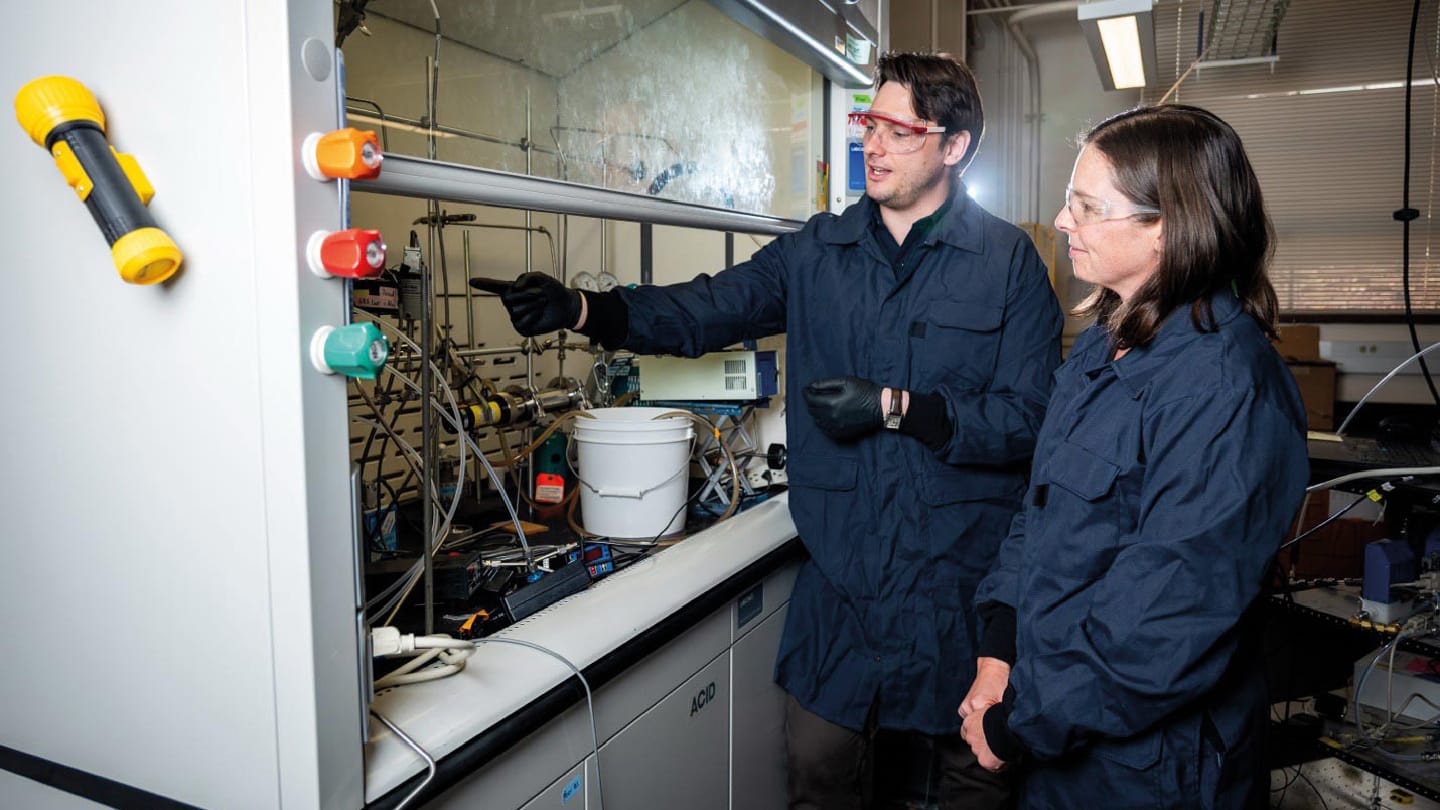
Reed: We start by shining light onto simple gases thought to be present in the early atmosphere, acting as a proxy for sunlight to induce chemistry. Our experimental setup is a flow-through system: we mix gases in a desired ratio and flow them into a reaction chamber equipped with an ultraviolet (UV) lamp. The UV lamp serves to mimic the UV light from the Sun and initiates chemistry.
The atmosphere of the early Earth is thought to be mildly reducing, with very little oxygen and a lot more carbon dioxide (CO2) and methane (CH4). Along with CO2 and CH4, we use a trace sulfur gas – hydrogen sulfide (H2S) – which can be emitted from surface processes such as volcanism.
Was there a key breakthrough or unexpected result that shifted your thinking?
Reed: What initially took me by surprise was the variety of sulfur-bearing biomolecules we were able to produce. More exciting still was that we could estimate the quantities – especially of the amino acid cysteine – that would be generated when scaled up to the size of Earth’s atmosphere: we estimate that, on a global scale, this chemistry could produce enough cysteine each year to match the amount contained in ~10²²–10²⁷ cells. For comparison, the total number of cells on Earth today is ~5 × 10³⁰. In other words, this could generate, in a single year, enough cysteine to stock a budding global ecosystem.
Browne: The key breakthroughs can all be traced to discussions within the interdisciplinary team. Collaboration with Caj (Neubauer), Cade (Christensen), and Jason (Surrat) provided the analytical measurements necessary to ensure we were measuring the molecules we thought we were, while Boswell (Wing) and Shawn motivated the search for specific molecules and placed the results in context of our understanding of early Earth and the development of metabolism.
Having an interdisciplinary team allowed us to design and execute experiments that wouldn’t have been feasible with our individual expertise alone.
What were the biggest challenges your team faced, and how did you overcome them?
Reed: At first, shipping our samples to our collaborators was logistically difficult as they couldn’t be exposed to air until right before analysis. We ended up placing the samples into sealed vials, before placing those vials in vacuum-sealed food-storage bags.
It was also the first time we had used the Orbitrap mass spectrometer, a very sensitive instrument, for our measurements. Initially, we had to ensure our samples were sufficiently diluted (by a factor of 10,000) to avoid damaging the instrument or introducing compounds that couldn’t be easily removed.
Browne: Sulfur gases are notoriously challenging to work with – they are sticky and it is easy to contaminate your system. Additionally, we need to work with trace levels – parts per million by volume – to be relevant to the early atmosphere. Good cleaning protocols and control experiments were critical in demonstrating that the compounds of interest were being made in the experiment and not a result of contamination. Given the low sulfur quantities, we also had to use state-of-the-art instrumentation to measure these compounds. While this chemistry could feasibly create significant amounts of these compounds when considering the whole atmosphere, our experiment takes place in a reaction cell the size of a small water bottle. There isn’t much sample to work with!
McGlynn: We spent a lot of time talking about how to extract molecules from haze and get them into the mass spectrometer.
Reed: Expanding on Shawn’s point, we had to figure out how to extract as much as possible from the filter samples while being compatible with the instrumentation and being consistent with Cade and Jason’s methods at UNC. It took a lot of discussion and trial and error, but our stellar team was able to land on something that worked very well, with a method that I think will likely be used for more experiments to come!
How do these findings reshape the discussion around where and how life could first take hold?
Reed: Well, I think many in this field were unconvinced that life had sulfur biomolecules available at its start. This was due to two reasons: to date, there haven’t been any detections of sulfur amino acids, like cysteine, on meteorites (a proposed delivery mechanism for many biomolecules); and sulfur biomolecules have been quite difficult to create in prebiotic chemistry experiments. This led many to propose that life could have started without molecules such as cysteine, instead evolving to incorporate them later. Our findings suggest an alternative: that these molecules could have been rained down from the atmosphere in very large amounts all over the globe.
I also believe this work could have implications for how we interpret sulfur signatures on other planets. In a separate study, we showed that the same chemistry can produce dimethyl sulfide (DMS) – often proposed as a robust biosignature – but that it can also form through atmospheric processes. In the context of the present study, it’s not yet clear whether astronomers could detect signatures of the molecules we report: they appear at low abundance and, in this chemistry, are embedded within complex organic particles.
That said, I’d be interested to see a scenario where astronomers observed an exoplanet that had similar atmospheric chemistry to these experiments. Perhaps then we could infer that these biomolecules could also be made there, and that there could be a “prebiotic potential” for that planet.
McGlynn: This study provides a deeper awareness that the "molecules of life" are sort of "normal" molecules; the "trick" of life is to arrange them in particular combinations and then make more of itself from that arrangement.
To put it another way, life is a process that continuously makes itself. Previously, researchers believed that some of the molecules identified in this study were "biological inventions," but now we know we could expect them on the early Earth or another planet.
Looking ahead, what are the next steps to build on this research?
Reed: There are many different paths that this research could branch into. Broadly, I hope our results lead to more research that incorporates these sulfur biomolecules in experiments which relate to prebiotic chemistry and early life, given that the atmosphere could be a significant source of these molecules. Personally, I think more can be done to explore how these products react after they rain out of the atmosphere onto surface environments, such as minerals, rocks or water.
Browne: What’s exciting about this work is that the results of each project suggest several new possibilities to study next. In addition to the experiments Nate described, it will be important to consider what the lifetime of these molecules would be in the atmosphere. Do they survive transport to the surface, or are they reacted away? There is also much work to be done in examining the effects variations in atmospheric composition could have on the source of these molecules. This aspect is particularly interesting when thinking about the potential for life on other planets.
McGlynn: In this study, we focused on organosulfur compounds because they seemed to not be found in abiotic environments. There are many other molecules in the mixture, and taking the time to identify those will be important.
Going further, it will be interesting to integrate these molecules into process types of experiments to learn how they can promote change, and even perhaps chemical evolution.
Nathan W. Reed is a NASA Postdoctoral Program Fellow at the University of Colorado Boulder, USA.
Eleanor C. Browne is an Associate Professor in the Department of Chemistry and a CIRES Institute Fellow at the University of Colorado Boulder, USA.
Shawn McGlynn is a Principal Investigator and Associate Professor at the Earth-Life Science Institute, Institute of Science Tokyo, Japan.
Newsletters
Receive the latest analytical science news, personalities, education, and career development – weekly to your inbox.