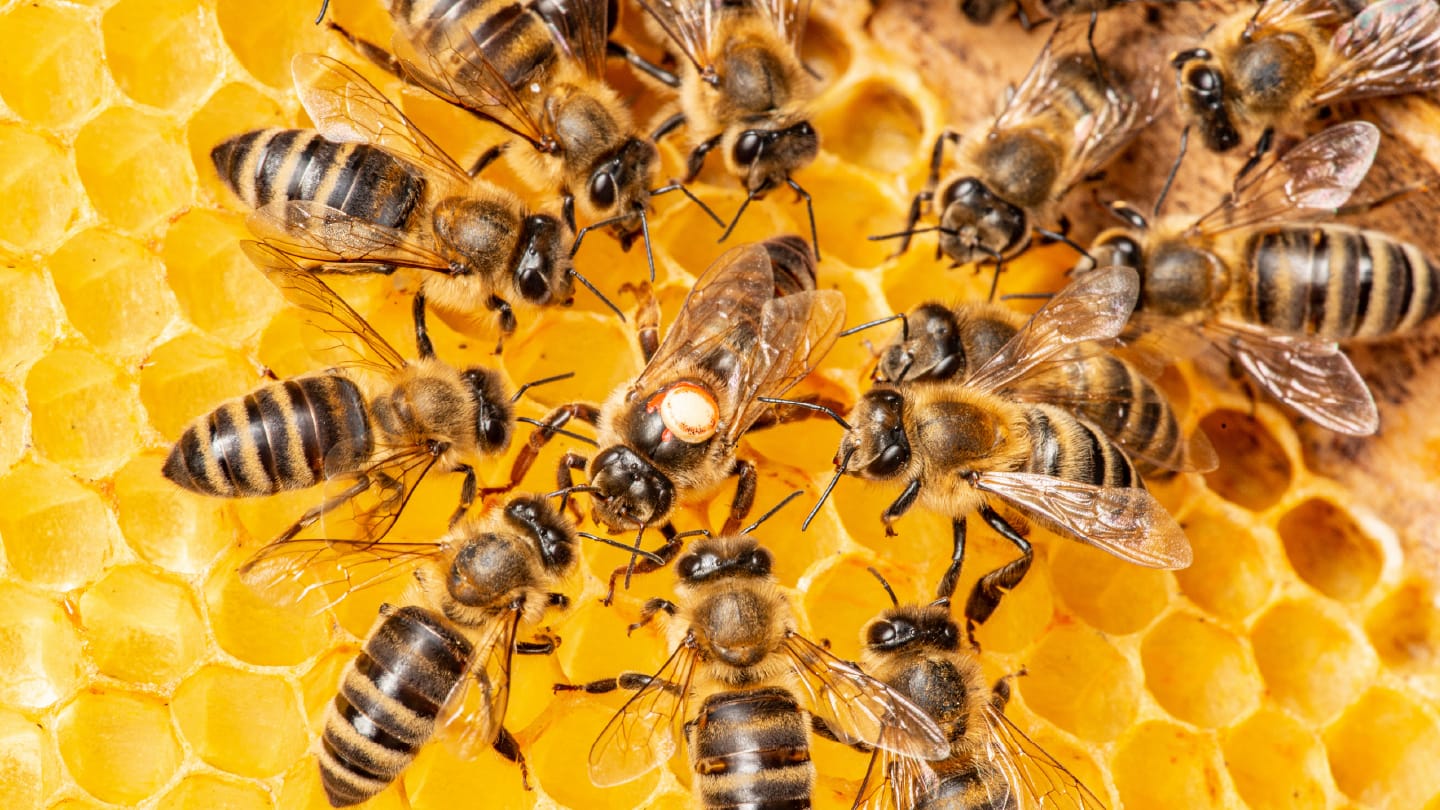
Honeybee queens can transfer pesticide residues into their eggs when colony-level defenses are overwhelmed, revealing a route by which chronic contamination may move from workers and wax into the next generation.
The study followed radiolabeled methyl parathion through laboratory honeybee “nanocolonies,” each containing one queen and 60 worker bees. After feeding the colonies carbon-14-tagged pesticide, researchers used biological accelerator mass spectrometry (BioAMS) – a radiotracer approach that detects carbon-14-labeled compounds at very low levels in biological samples – to trace pesticide flux over 10 days across source diet, stored food, worker bodies, wax, queen tissue, ovaries, and eggs. The sensitivity of the workflow allowed the team to quantify contamination in low-biomass samples that are difficult to assess using conventional residue methods.
The measurements showed that worker bees initially reduced the pesticide load before it reached the queen. Methyl parathion levels were far lower in diet stored in comb cells than in the source feeders, suggesting that workers were filtering, processing, and redirecting contamination into hive materials. Over time, however, the stored diet became more contaminated, indicating that this buffering capacity weakened under chronic exposure.
“In our study, pesticides began to accumulate in queens over time, suggesting that worker filtration capacity can be overwhelmed,” lead author Angela Encerrado-Manriquez said in a recent press release. “When this happens, queens have their own defense. Maternal offloading allows them to shunt the toxic burden to their eggs.”
The same radiotracer measurements revealed a second route of redistribution. Queens carried much lower whole-body pesticide burdens than workers, but methyl parathion was still detected along the reproductive pathway. By day 10, concentrations were higher in eggs than in queen bodies or ovaries, consistent with maternal offloading rather than simple accumulation in the queen herself.
The queen’s presence also shifted colony-wide chemical distribution, increasing pesticide deposition in wax and altering worker exposure patterns. The authors argue that standard queenless worker assays may therefore miss important routes of chronic contamination, especially those affecting embryos and brood.
“When pesticides accumulate to the extent that the queen bee has eggs that are so loaded they may no longer develop properly, there could be a tipping point,” said senior author Sascha Nicklisch. “There may be a slow creeping effect of chemical accumulation that will contribute to delayed colony collapse.”
How long queens can continue offloading pesticides, whether contaminated eggs develop normally, and how the effect varies across pesticide classes remain open questions. For now, the study suggests that colony-level protection may become a vulnerability once chronic exposure overwhelms the social buffering system.
Newsletters
Receive the latest analytical science news, personalities, education, and career development – weekly to your inbox.