Conexiant
Login
  • The Analytical Scientist
  • The Cannabis Scientist
  • The Medicine Maker
  • The Ophthalmologist
  • The Pathologist
  • The Traditional Scientist
The Analytical Scientist
  • Explore

    Explore

    • Latest
    • News & Research
    • Trends & Challenges
    • Keynote Interviews
    • Opinion & Personal Narratives
    • Product Profiles
    • App Notes
    • The Product Book

    Featured Topics

    • Mass Spectrometry
    • Chromatography
    • Spectroscopy

    Issues

    • Latest Issue
    • Archive
  • Topics

    Techniques & Tools

    • Mass Spectrometry
    • Chromatography
    • Spectroscopy
    • Microscopy
    • Sensors
    • Data and AI

    • View All Topics

    Applications & Fields

    • Clinical
    • Environmental
    • Food, Beverage & Agriculture
    • Pharma and Biopharma
    • Omics
    • Forensics
  • People & Profiles

    People & Profiles

    • Power List
    • Voices in the Community
    • Sitting Down With
    • Authors & Contributors
  • Business & Education

    Business & Education

    • Innovation
    • Business & Entrepreneurship
    • Career Pathways
  • Events
    • Live Events
    • Webinars
  • Multimedia
    • Video
    • Content Hubs
Subscribe
Subscribe

False

The Analytical Scientist / Issues / 2026 / March / Deep UV Raman Reveals mRNA Encapsulation in Lipid Nanoparticles
Pharma and Biopharma News and Research Pharma and Biopharma

Deep-UV Raman Reveals mRNA Encapsulation in Lipid Nanoparticles 

Spectroscopic analysis reveals lipid–RNA interactions governing nanoparticle formulation efficiency 

03/13/2026 2 min read

Share

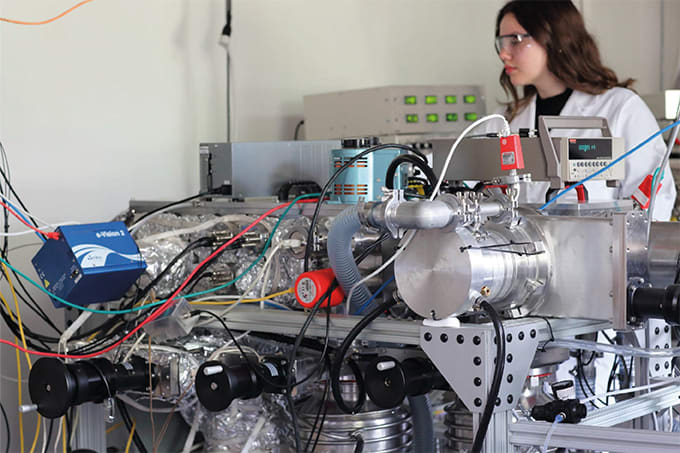
The Lednev lab uses a laser technique called Raman spectroscopy to analyze the chemical composition of materials. Credit: Patrick Dodson

A deep-ultraviolet Raman spectroscopy approach may offer a new way to evaluate how messenger RNA (mRNA) is packaged inside lipid nanoparticles (LNPs), a key step in the development of mRNA vaccines and therapeutics.  

Researchers at the University at Albany, SUNY demonstrated that the technique can distinguish between encapsulated and free mRNA molecules within nanoparticle formulations. Because lipid nanoparticles protect fragile RNA molecules and deliver them into cells, assessing encapsulation efficiency is a key step in formulation and quality control. 

“mRNA therapeutics have emerged as a powerful tool for treating a wide range of diseases, but their clinical success depends on overcoming issues of instability and delivery,” said Igor Lednev, University at Albany, who led the study. “Raman spectroscopy offers us unique information that can help ensure mRNA is fully encapsulated inside lipid nanoparticles, ensuring the safety and effectiveness of these therapeutics.” 

In the study, the researchers used deep-UV resonance Raman (DUVRR) spectroscopy, which measures molecular vibrations by detecting how laser light scatters from a sample. Using a deep-UV excitation wavelength of 266 nm – close to the absorption maximum of nucleic acids – the method selectively enhances Raman signals from the mRNA while minimizing interference from surrounding lipids. 

The team prepared model vaccine formulations containing different ratios of mRNA and lipid nanoparticles, generating samples with fully encapsulated, partially encapsulated, and free RNA molecules. Analysis of the resulting spectra revealed distinct vibrational markers associated with lipid–mRNA interactions. In particular, a Raman band near 1322 cm⁻¹ was linked to lipid-bound mRNA, while a band near 1329 cm⁻¹ corresponded to free RNA molecules. 

To interpret these spectral differences, the team combined Raman measurements with principal component analysis and two-dimensional correlation spectroscopy. The analysis showed that changes in the 1322 cm⁻¹ signal tracked the degree of mRNA encapsulation, suggesting it could serve as a quantitative indicator of nanoparticle formulation efficiency. The study also applied a two-trace two-dimensional correlation spectroscopy (2T2D-COS) approach to isolate spectral contributions linked specifically to lipid–mRNA interactions. 

“Raman spectroscopy allows us to analyze mRNA inside lipid nanoparticles without damaging it,” said Alexander Shekhtman, a collaborator on the study. “This means we can optimize formulations to improve both safety and effectiveness.” 

The researchers suggest that the approach could eventually support formulation screening and quality control for mRNA-based therapeutics, offering a nondestructive way to monitor encapsulation during development and manufacturing. 

Newsletters

Receive the latest analytical science news, personalities, education, and career development – weekly to your inbox.


Newsletter Signup Image

False

Advertisement

Recommended

False

Related Content

Loading the Molecular Dice
Pharma and Biopharma
Loading the Molecular Dice

December 12, 2024

2 min read

How a framework for controlling molecular reactions at the atomic scale has potential implications for nanotechnology, pharmaceutical synthesis, and clean energy research

CD-MS: To Megadalton and Beyond
Pharma and Biopharma
CD-MS: To Megadalton and Beyond

October 1, 2024

10 min read

Charge-detection mass spectrometry (CD-MS) has extended the range of MS to gigadalton-sized viruses and polymers; and with a commercial instrument in development and exciting new applications in complex protein mixtures, maturity beckons

New NMR Technique Enables Direct Detection of Molecular Chirality
Pharma and Biopharma
New NMR Technique Enables Direct Detection of Molecular Chirality

October 1, 2024

1 min read

Researchers develop an NMR method to distinguish between enantiomers without the need for chiral agents

Mass Spec Imaging Meets Proteomics
Pharma and Biopharma
Mass Spec Imaging Meets Proteomics

October 2, 2024

2 min read

Researchers combine tissue imaging with proteomics to shed light on the neurotoxic effects associated with HIV medication Efavirenz treatment

False

The Analytical Scientist
Subscribe

About

  • About Us
  • Work at Conexiant Europe
  • Terms and Conditions
  • Privacy Policy
  • Advertise With Us
  • Contact Us

Copyright © 2026 Texere Publishing Limited (trading as Conexiant), with registered number 08113419 whose registered office is at Booths No. 1, Booths Park, Chelford Road, Knutsford, England, WA16 8GS.