Conexiant
Login
  • The Analytical Scientist
  • The Cannabis Scientist
  • The Medicine Maker
  • The Ophthalmologist
  • The Pathologist
  • The Traditional Scientist
The Analytical Scientist
  • Explore

    Explore

    • Latest
    • News & Research
    • Trends & Challenges
    • Keynote Interviews
    • Opinion & Personal Narratives
    • Product Profiles
    • App Notes
    • The Product Book

    Featured Topics

    • Mass Spectrometry
    • Chromatography
    • Spectroscopy

    Issues

    • Latest Issue
    • Archive
  • Topics

    Techniques & Tools

    • Mass Spectrometry
    • Chromatography
    • Spectroscopy
    • Microscopy
    • Sensors
    • Data and AI

    • View All Topics

    Applications & Fields

    • Clinical
    • Environmental
    • Food, Beverage & Agriculture
    • Pharma and Biopharma
    • Omics
    • Forensics
  • People & Profiles

    People & Profiles

    • Power List
    • Voices in the Community
    • Sitting Down With
    • Authors & Contributors
  • Business & Education

    Business & Education

    • Innovation
    • Business & Entrepreneurship
    • Career Pathways
  • Events
    • Live Events
    • Webinars
  • Multimedia
    • Video
    • Content Hubs
Subscribe
Subscribe

False

The Analytical Scientist / Issues / 2026 / May / An Interstellar Signal Captured in Antarctic Ice
Environmental Environmental News and Research

An Interstellar Signal Captured in Antarctic Ice 

Iron-60 measurements suggest Earth is sampling supernova-seeded material in the Local Interstellar Cloud 

05/19/2026 2 min read

Share


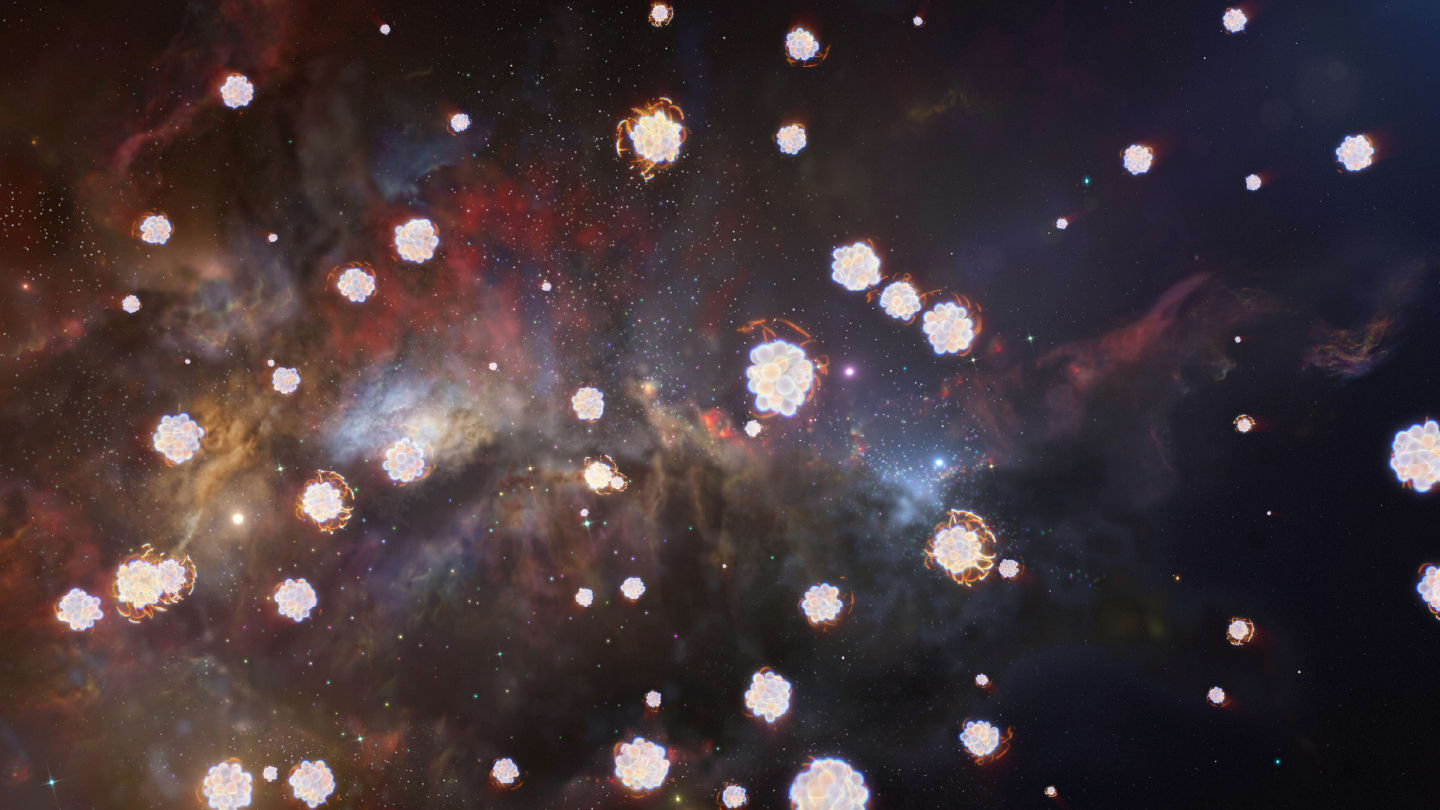
Credit: Chemical elements in a distant gas cloud (eso2306a) by ESO/L. Calçada, M. Kornmesser <https://commons.wikimedia.org/wiki/File:Chemical_elements_in_a_distant_gas_cloud_(eso2306a).jpg>, CC BY 4.0 <https://creativecommons.org/licenses/by/4.0>, via Wikimedia Commons

A rare radioactive isotope isolated from Antarctic ice has strengthened the case that the Solar System is currently moving through interstellar material seeded by an ancient stellar explosion.  

By tracing iron-60 in ice deposited between 40,000 and 81,000 years ago, researchers found a lower influx than in younger Antarctic snow and marine sediments, a pattern consistent with Earth sampling a structured Local Interstellar Cloud rather than the fading aftermath of an older supernova. 

The study builds on earlier detections of iron-60 in recent snow and deep-sea sediments, which hinted that the Local Interstellar Cloud might act as a long-lived reservoir for supernova debris. But those findings did not rule out other possibilities, including a slow decline from better-known supernova signals recorded millions of years ago. The new ice-core record extends that timeline into the interval when the Solar System may have been entering the cloud. 

“Our idea was that the Local Interstellar Cloud contains iron-60 and can store it over long time periods,” said Dominik Koll in the team’s press release. “As the Solar System moves through the cloud, Earth could collect this material. However, we couldn’t prove this at the time.” 

To test that idea, the team analyzed about 295 kilograms of EPICA Dronning Maud Land ice-core meltwater from Antarctica. To check that storage and chemical processing had not erased the signal, they first measured beryllium-10 and aluminum-26 at the DREAMS accelerator mass spectrometry facility in Dresden. Their expected abundances indicated that major losses were unlikely. 

At the Heavy Ion Accelerator Facility in Canberra, the researchers then used accelerator mass spectrometry to count individual iron-60 atoms and compared them with manganese-53 using the ^60Fe/^53Mn ratio, a sensitive way to distinguish interstellar iron-60 from expected cosmogenic background in dust and meteorites. 

Compared with recent Antarctic snow and Indian Ocean sediments, the ice-core record suggests that less iron-60 reached Earth between 40,000 and 80,000 years ago than in more recent times. The authors argue that this variable profile favors the Local Interstellar Cloud, or the wider cloud complex around it, over a simple long-term fade-out from older supernova ejecta. 

“This means that the clouds surrounding the Solar System are linked to a stellar explosion,” said Koll. “And for the first time, this gives us the opportunity to investigate the origin of these clouds.” 

The team now aims to push the record farther back, using older, high-resolution archives to trace the Solar System’s path through the surrounding interstellar environment in finer detail. 

Newsletters

Receive the latest analytical science news, personalities, education, and career development – weekly to your inbox.

Newsletter Signup Image

False

Advertisement

Recommended

False

Related Content

 This Week’s Mass Spec News
Environmental
This Week’s Mass Spec News

April 4, 2025

2 min read

The Climate Conversation: Part Two – Michael Gonsior
Environmental
The Climate Conversation: Part Two – Michael Gonsior

December 5, 2024

7 min read

In the second part of our interview, Michael Gonsior explores the pressing challenges in carbon cycle research, transformative tools and technologies, as well as analytical glimmers of hope

More Bang for Your Buck
Environmental
More Bang for Your Buck

December 4, 2024

1 min read

Researchers develop more stable catalysts for dry reforming of methane – a promising method for carbon capture and utilization (CCU)

Portable PFAS Profiling
Environmental
Portable PFAS Profiling

December 13, 2024

1 min read

Using nanopore technology, Chang Liu and Xiaojun Wei discuss their accessible and inexpensive new option for detecting “forever chemicals” PFAS

Affiliations:

Specialties:

Areas of Expertise:

Contributions:

False

The Analytical Scientist
Subscribe

About

  • About Us
  • Work at Conexiant Europe
  • Terms and Conditions
  • Privacy Policy
  • Advertise With Us
  • Contact Us

Copyright © 2026 Texere Publishing Limited (trading as Conexiant), with registered number 08113419 whose registered office is at Booths No. 1, Booths Park, Chelford Road, Knutsford, England, WA16 8GS.