A New Ionization Route for Amino Metabolites
A tocopherol-based derivatization reagent uses laser post-ionization rather than fixed charge to detect amino-containing metabolites in tissue.
A new on-tissue derivatization strategy has extended mass spectrometry imaging of amino-containing metabolites by replacing the usual fixed-charge design with a photoionizable chromophore.
In the new study, Shane Ellis and colleagues introduced TAC/OS, a tocopherol-based reagent that tags primary amines and is selectively detected as a radical cation in the presence of laser post-ionization, or MALDI-2. Rather than relying on a permanently charged derivatization tag to improve ionization, the workflow uses a chromophore that can be photoionized after desorption.
After confirming that TAC/OS retained the photoionization behavior of its parent chromophore, the researchers tested it against standards including γ-aminobutyric acid, serotonin, and dopamine. Tandem mass spectrometry identified characteristic reagent-derived fragments, helping distinguish derivatized features in more complex samples.
In murine brain, a chloroform prewash improved detection for 13 of 15 definitively identified metabolites, and the optimized workflow localized dozens of derivatized features, including amino acids, small alkyl amines, glutathione, γ-aminobutyric acid, dopamine, and related metabolites. The reported ion images were consistent with expected biological distributions, including dopaminergic signals in the caudate putamen.
Across three tissue types, the protocol detected and localized more than 30 metabolites, including 20 amino acids, while imaging at 10 μm pixel size showed minimal delocalization. Although the study remains a proof of concept, its application to late-stage pancreatic cancer xenografts supports photoionizable chromophores as an alternative design route when fixed-charge reagents are unsuitable.
HDX-MS at Residue Resolution
The workflow shows how opposite exchange changes at neighboring residues can cancel out in conventional bottom-up HDX-MS.
A site-specific hydrogen–deuterium exchange workflow distinguishes how five ligands bind the same pocket on WDR5, while resolving residue-level changes hidden by conventional peptide averaging.
Conventional bottom-up hydrogen–deuterium exchange mass spectrometry (HDX-MS) tracks changes in deuterium uptake across peptide segments, typically averaging the behavior of five or more amino acids. The researchers instead used low-energy electron capture dissociation to fragment deuterium-labeled peptides without scrambling the label between exchangeable sites.
The team compared the site-specific profiles with an earlier peptide-level analysis of three small molecules and two peptide-based ligands. Seven representative peptides were examined across the binding site and more distant regions affected allosterically.
In one binding-site segment, conventional analysis returned almost no change upon ligand binding. The residue-level measurements showed why: reduced exchange at serine 91 was offset by increased exchange at neighboring isoleucine 90, cancelling the signal when averaged across the peptide. A second region showed no amino-acid-level shift, consistent with a ligand contact through a side chain that left the protein backbone largely unchanged.
At cysteine 261, exchange differences broadly tracked the ligands’ known affinity ranking and were consistent with a water-mediated hydrogen bond at that site. Signals at other residues did not follow the same order, showing that affinity ranking depends on selecting a structurally informative site. The residue-level profiles also distinguished same-site binders through the different allosteric effects they produced elsewhere in WDR5.
Because acquisition and analysis remain largely manual, the study focuses on selected peptides. The authors suggest that dedicated software could extend site-specific HDX-MS across full exchange time courses, helping distinguish binding modes, trace allosteric effects, and recover changes concealed by peptide averaging.
Faster Motif Mining for MS/MS
MS2LDA 2.0 accelerates Mass2Motif mining while MAG helps users judge which motif annotations are likely to be reliable.
A new study presents MS2LDA 2.0, an updated version of the Mass2Motif-mining workflow that identifies recurring fragment and neutral-loss patterns across large datasets and links them to shared chemical substructures. The authors also introduce Mass2Motif Annotation Guidance, or MAG, an automated system designed to help interpret those recurring patterns and reduce one of the more time-consuming parts of the original workflow: manual motif annotation.
The gain in scale is central to the update. According to the authors, MS2LDA 2.0 can analyze datasets up to 14 times faster than its predecessor, making larger untargeted MS/MS collections more tractable. To test MAG, the team benchmarked it against previously curated motif sets from urine, GNPS, and MassBank data. Agreement was strongest for the library-derived sets, while experimentally derived motifs proved more difficult, reflecting the noisier and more heterogeneous spectra likely to be encountered in practice.
The method was also evaluated on a larger spectral library, where it helped distinguish higher-confidence motif annotations from less reliable ones. Among 1,000 modeled Mass2Motifs, 158 produced high-quality annotations and a further 176 fell into an intermediate range, giving users a clearer sense of which recurring patterns are likely to support meaningful substructure interpretation and which are better treated more cautiously.
The paper also demonstrates the approach on applications including pesticide-related substructures in food and potentially unknown fungal metabolites. In those examples, the value lies less in fully identifying every molecule than in pulling out recurring chemical features from complex datasets, particularly when complete structural annotation remains difficult.
The authors argue that these advances could make it easier to uncover meaningful chemical patterns in complex datasets, particularly when complete structural elucidation is not feasible.
Reconstructing Missing Proteomics Data
The Bayesian workflow improves sample-median recovery, marker detection, and cell-cycle prediction in proteomics datasets with substantial missingness.
A Bayesian imputation framework has outperformed ten established methods for reconstructing missing values in label-free proteomics, improving normalization and downstream analysis across synthetic, patient-tissue, and single-cell datasets.
The method, called msBayesImpute, combines Bayesian matrix factorization with protein-specific dropout models. This allows it to account for both technical missingness and the abundance-dependent loss of low-abundance proteins near or below an instrument’s detection limit.
Across synthetic benchmarks, msBayesImpute recovered protein-specific dropout behavior and maintained stable performance up to about 70 percent missingness. It also reconstructed sample medians more accurately than competing approaches, providing a stronger basis for normalization. In semi-synthetic HeLa datasets containing either 50 or 561 samples, that advantage persisted as the proportion of abundance-dependent missingness increased.
A serial dilution experiment using matched tumor and tumor-free lung adenocarcinoma tissue from ten patients provided an experimental ground truth. Values present in undiluted samples but absent after dilution were treated as known missing measurements. Under those conditions, msBayesImpute reduced reconstruction error by approximately 20 percent relative to the second-best method and recovered sample-wise abundance with lower variability.
In a single-cell proteomics dataset containing 45 percent missing values, the framework also improved marker recovery and cell-cycle prediction. It detected 18 of 20 G2–M cell-cycle markers, compared with eight using a competing dropout model, and produced the lowest prediction error among the methods tested.
Available in R and Python, msBayesImpute does not require a predefined experimental design, although performance becomes less stable in cohorts with fewer than six samples. The authors suggest that models pretrained on large public datasets could extend the method to smaller studies, while the same dropout logic may also be adaptable to phosphoproteomics, metabolomics, and lipidomics.
(Mass) Spectacular and Strange
Hot Beetle Summer
Heatwaves can change behavior in predictable ways: shorter tempers, slower commutes, and a scramble toward any pocket of shade in sight. Few would have expected, however, the effect that rising temperatures seem to be having in burying beetles.
In research presented at the Society for Experimental Biology conference in Florence, scientists examined same-sex mounting in Nicrophorus vespilloides, a beetle species that raises its larvae on buried animal carcasses. The project compared male-male mounting under control conditions at 20°C and during a simulated three-day heatwave at 26°C, before extracting cuticular hydrocarbons from the beetles’ bodies for gas chromatography–mass spectrometry analysis.
Those cuticular hydrocarbons (CHCs) help insects prevent water loss while also carrying chemical signals used in mate recognition. “Evidence suggests that there is a trade-off between the signalling and waterproofing functions of CHCs,” said Solène Morelle, a PhD student at the University of St Andrews. “This indicates that heat-induced changes in CHC profiles may alter behavioural and reproductive outcomes.”
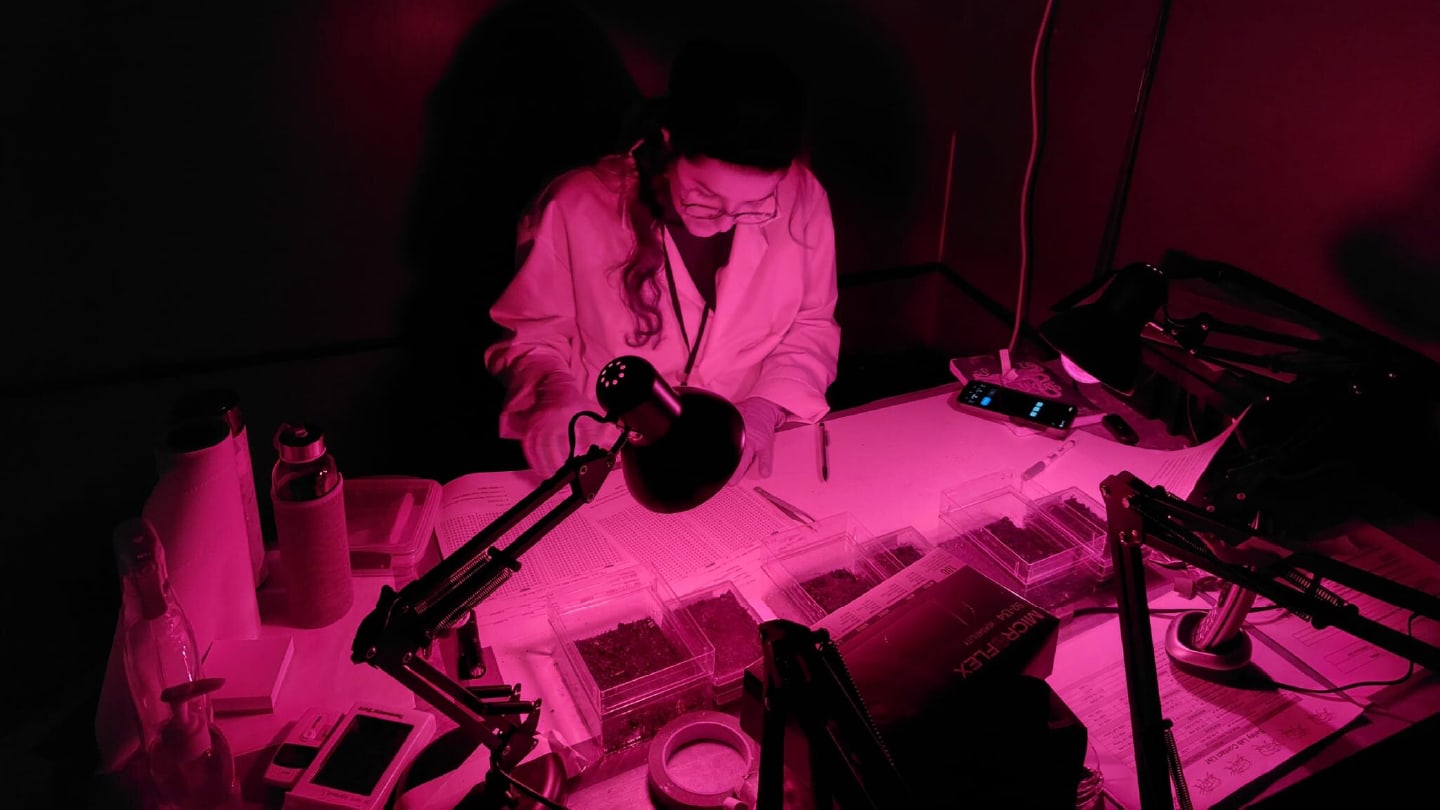
Preliminary results suggested that heat stress increased same-sex mounting, though the behavior was not confined to warmer conditions. “I was surprised to find out how much same-sex mounting the beetles showed even under normal conditions,” said Morelle. “And what I did not expect was the increase in reciprocal mounting under heat stress – we don’t yet know what this means!”
The mechanism is still being tested, but the team is investigating whether heat shifts CHC profiles toward longer-chain compounds that limit water loss, at the expense of shorter-chain signals that are easier for mates to detect.
Newsletters
Receive the latest analytical science news, personalities, education, and career development – weekly to your inbox.