Strain Mapping at the Picometer Scale
Tiny shifts in out-of-plane polariton resonances provide a non-destructive optical readout of hidden interlayer compression.
A new optical method can detect picometer-scale distortions between the layers of van der Waals materials, offering a non-destructive way to map hidden strain that can influence device performance.
The approach was demonstrated in hexagonal boron nitride, where tiny changes in interlayer spacing shift the frequency of out-of-plane transverse optical phonons. These vibrations are normally almost invisible to conventional spectroscopy because they interact only weakly with light. The team instead tracked mid-infrared hyperbolic polaritons linked to those phonons, turning minute structural changes into measurable shifts in the optical spectrum.
High-pressure Fourier-transform infrared spectroscopy provided the first validation. The researchers patterned hBN into fishnet gratings, allowing free-space light to excite the deeply subwavelength polariton modes. They then compressed the material in a diamond anvil cell. Increasing pressure produced a pronounced redshift in the out-of-plane polariton resonance, while in-plane phonons and polaritons changed little. Comparison with density functional theory and electromagnetic simulations linked the spectral shift quantitatively to interlayer compression, with a detection sensitivity of about 10 picometers.
To test whether the method could resolve localized deformation at a buried interface, the researchers examined tellurium quantum dots inside boron nitride nanotubes using monochromated scanning transmission electron microscopy–electron energy loss spectroscopy. Localized polariton redshifts of roughly 11–21 cm−1 appeared near the quantum dots, consistent with picometer-scale compression predicted by molecular dynamics simulations. Continuous tellurium nanowires produced no comparable shift, helping rule out a simple dielectric-environment effect.
By combining ensemble-scale infrared spectroscopy with localized electron energy loss measurements, the study extends strain mapping into the out-of-plane direction and buried nanostructures. The authors suggest that polariton-based picometrology could enable in situ mapping of buried strain in van der Waals heterostructures, helping connect interlayer mechanics with changes in electronic and optical performance.
Raman Optical Activity in an Unexpected Crystal
Circularly polarized Raman spectroscopy reveals strong optical activity in a centrosymmetric, nonmagnetic ferroaxial crystal.
Raman optical activity (ROA), traditionally associated with chiral molecules and magnetic materials, has now been observed in an achiral, nonmagnetic crystal using circularly polarized Raman spectroscopy.
The effect was observed in nickel titanium oxide, a centrosymmetric crystal with ferroaxial order. Coordinated atomic rotations create a preferred rotational direction within the lattice while preserving inversion symmetry, so the crystal remains achiral overall.
“We demonstrated for the first time that ROA can arise in a centrosymmetric and nonmagnetic crystal, overturning the conventional view that ROA requires either structural chirality or magnetic order,” said Takuya Satoh of the Institute of Science Tokyo in the university’s press release.
The researchers compared Raman scattering under left- and right-circularly polarized configurations. At 785 nanometers, several vibrational modes produced clear differences in scattered intensity, with the strongest reaching a normalized ROA of about 1.0, several orders of magnitude larger than values typically reported for chiral molecules.
The response depended on ferroaxial domain orientation. Measurements from opposite faces of a single-domain crystal reversed the sign of the Raman intensity difference, while mapping a multidomain sample reproduced the pattern seen with electrogyration imaging. Little or no response appeared outside the crystal or near cracks, helping rule out instrumental offsets.
The effect weakened at 532 nanometers and disappeared at 633 nanometers, indicating resonant enhancement at 785 nanometers through electronic transitions in nickel ions. Symmetry analysis and model calculations linked the response to unequal coupling between clockwise and counterclockwise rotational phonons.
“The findings expand the concept of chirality and open new avenues for materials discovery and optical measurement techniques,” said Satoh. More specifically, the study shows that circularly polarized Raman spectroscopy can distinguish opposite ferroaxial domain orientations, providing a route to map structural order that is invisible to conventional chirality-based measurements.
How Proteins Really Breathe
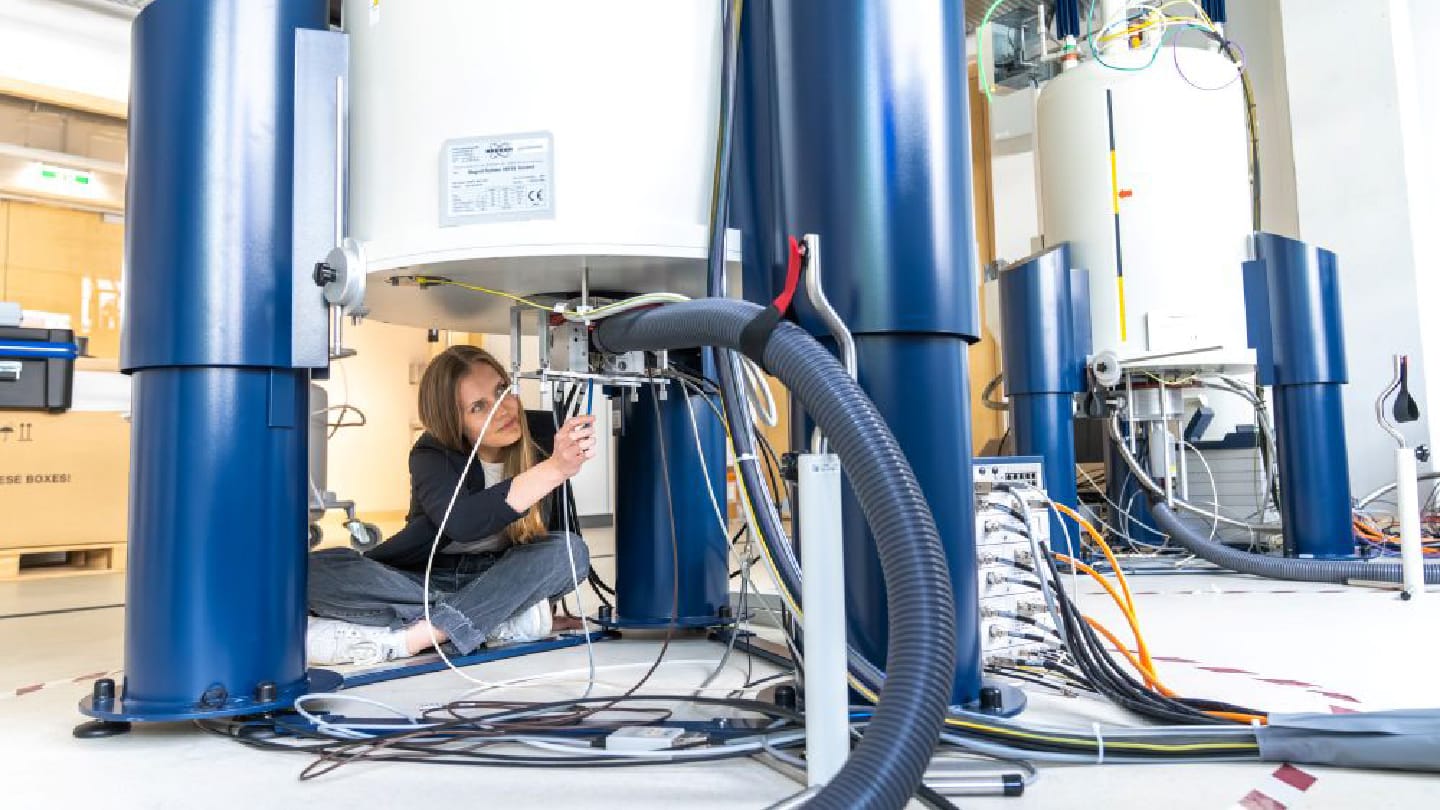
The study challenges the idea of a single global breathing mode, pointing instead to residue-specific local pathways through the protein core.
A combined NMR and molecular modeling study has shown how strongly a protein’s environment can reshape its internal motion, with crystal packing slowing some aromatic ring flips by nearly three orders of magnitude.
Researchers at the Institute of Science and Technology Austria used the immunoglobulin-binding protein GB1 as a model, comparing its dynamics in solution, in crystals, and when bound to immunoglobulin G. Buried aromatic rings served as reporters because their 180-degree flips require coordinated movement through the protein core.
“For aromatic rings to flip, the entire protein needs to move considerably,” said first author Lea Becker in ISTA’s press release. “So, by looking at how fast aromatic rings flip inside a protein’s core and in an enzyme’s active site during binding, we can read out how freely it can breathe.”
Using advanced isotope labeling, the team tracked individual aromatic sites with solution-state and magic-angle-spinning solid-state NMR, while X-ray crystallography defined nearby molecular contacts. Two buried tyrosine rings flipped tens of thousands of times per second in solution but only around 18–56 times per second in the crystal. The same motions occurred far more rapidly in the IgG-bound complex, showing that intermolecular contacts can reshape rather than simply suppress protein dynamics.
Enhanced-sampling molecular dynamics simulations reproduced the higher free-energy barriers in the crystal and linked them to contacts with neighboring protein molecules. The results also challenged the idea of a single global “breathing motion,” suggesting that different aromatic residues move through distinct local pathways.
“Machine-designed proteins have been optimized to reproduce static structures. But these frozen structures likely don’t provide access to the full array of functional conformations in nature,” said senior author Paul Schanda.
“By uncovering protein dynamics experimentally, we may be able to model and design proteins with better functional relevance in the future.”
Glycan Spectra in Motion with DynaSpec
Population-weighted modeling links glycan conformations to Raman spectra and improves discrimination between closely related structures.
A new computational framework, DynaSpec, uses ensemble-aware modeling to explain how glycan conformations shape Raman spectra and to sharpen discrimination between closely related structures.
Developed by researchers at Stanford University, DynaSpec combines machine-learning-assisted metadynamics, density functional theory calculations, and experimental Raman spectroscopy. The simulations map the conformations accessible to flexible biomolecules and estimate their equilibrium populations, while Raman spectra calculated for representative conformers are combined according to their thermodynamic populations.
Raman measurements across 13 N-glycan standards showed that branching, fucosylation, and sialylation leave subtle but reproducible signatures across the spectrum. A classifier distinguished the glycans with average accuracy above 85 percent, and the population-weighted calculations closely reproduced the measured peak positions, intensities, and overall envelopes.
The simulations also revealed a conserved switching motion in the α1,6-linked branch, with glycans moving between extended “open” and compact “curled” conformations. By tracing Raman-active modes back to specific glycosidic torsions and linkages, DynaSpec identified a spectral window between 1,000 and 1,400 cm−1 that was enriched in structurally informative vibrations.
Restricting the analysis to the torsion-rich window improved discrimination between two positional isomers with nearly identical full spectra, raising classification accuracy to 71 percent. Structure-guided windows also supported accurate unmixing of glycans differing in fucosylation or galactosylation, although the closest positional-isomer pair remained difficult to resolve.
The framework was extended computationally to O-glycans and glycosaminoglycans, with its predicted spectrum showing good agreement with experimental measurements of hyaluronic acid. That transferability suggests a broader route to interpreting flexible biomolecules through their full conformational ensembles rather than a single representative structure.
TES Comes to BESSY
Europe’s first synchrotron TES spectrometer opens soft X-ray emission measurements to monolayers, nanostructures, and highly dilute samples.
A superconducting transition-edge sensor array has entered operation at the BESSY II synchrotron, enabling soft X-ray emission measurements on atomically thin and highly dilute samples.
Developed by Helmholtz-Zentrum Berlin, the Max Planck Institute for Chemical Energy Conversion, and the US National Institute of Standards and Technology, the instrument is Europe’s first TES spectrometer installed at a synchrotron source. Its 248-pixel array detects the energy of individual X-ray photons directly, avoiding the gratings used in conventional wavelength-dispersive X-ray emission spectroscopy and resonant inelastic X-ray scattering instruments.
Each absorbed photon briefly heats a superconducting sensor, changing its resistance and producing a signal read through microwave SQUID multiplexing. A dilution refrigerator maintains the array at a 25-millikelvin bath temperature, while the attached ultrahigh-vacuum chamber supports samples between 10 and 300 kelvin.
The instrument achieved energy resolution of approximately 0.7–1.7 electronvolts across 260–890 electronvolts and detected up to 10,000 photons per second before pulse pile-up became significant. Its energy calibration remained stable to within 0.1 electronvolts over almost 10 hours.
“The superconducting Transition Edge Sensor array photon detector that we have now put into operation at BESSY II is around 100 to 1000 times more efficient to detect photons than conventional XES and RIXS spectrometers,” said instrument scientist Régis Decker in HZB’s press release.
The instrument is expected to expand XES and RIXS studies to monolayers, nanostructures, impurities, gated devices, and dilute molecular or protein systems that have largely remained beyond the practical reach of conventional spectrometers.
Newsletters
Receive the latest analytical science news, personalities, education, and career development – weekly to your inbox.