Conexiant
Login
  • The Analytical Scientist
  • The Cannabis Scientist
  • The Medicine Maker
  • The Ophthalmologist
  • The Pathologist
  • The Traditional Scientist
The Analytical Scientist
  • Explore

    Explore

    • Latest
    • News & Research
    • Trends & Challenges
    • Keynote Interviews
    • Opinion & Personal Narratives
    • Product Profiles
    • App Notes
    • The Product Book

    Featured Topics

    • Mass Spectrometry
    • Chromatography
    • Spectroscopy

    Issues

    • Latest Issue
    • Archive
  • Topics

    Techniques & Tools

    • Mass Spectrometry
    • Chromatography
    • Spectroscopy
    • Microscopy
    • Sensors
    • Data and AI

    • View All Topics

    Applications & Fields

    • Clinical
    • Environmental
    • Food, Beverage & Agriculture
    • Pharma and Biopharma
    • Omics
    • Forensics
  • People & Profiles

    People & Profiles

    • Power List
    • Voices in the Community
    • Sitting Down With
    • Authors & Contributors
  • Business & Education

    Business & Education

    • Innovation
    • Business & Entrepreneurship
    • Career Pathways
  • Events
    • Live Events
    • Webinars
  • Multimedia
    • Video
    • Content Hubs
Subscribe
Subscribe

False

The Analytical Scientist / Issues / 2026 / March / Shining a Light on Microplastic Transport in the Body
Translational Science Translational Science News and Research Clinical Environmental

Shining a Light on Microplastic Transport in the Body

NIR-II fluorescent labeling reveals how nanoscale plastic fragments move through the gut

03/16/2026 2 min read

Share

A fluorescent imaging approach that operates in the second near-infrared (NIR-II) window may offer a new way to track how microplastics move through the body in real time. 

Developed by researchers at the Tokyo University of Science, the method enables deep-tissue imaging of irregularly shaped nanoscale particles that more closely resemble environmental microplastics than the spherical models commonly used in laboratory studies.

The team developed fluorescent microplastic models by loading polymer fragments with NIR-II dyes, allowing their movement to be tracked in living systems. The particles were synthesized from several common plastics – including poly(ethylene terephthalate) (PET), polypropylene (PP), polyethylene (PE), and polystyrene (PS) – and ranged from roughly 30 to 300 nanometers in diameter.

Microplastics are now widely detected in air, water, food, and consumer products, and concerns have grown about their potential accumulation in organs such as the liver, lungs, and brain. However, how these particles move through biological systems – and whether they cross tissue barriers – remains poorly understood.

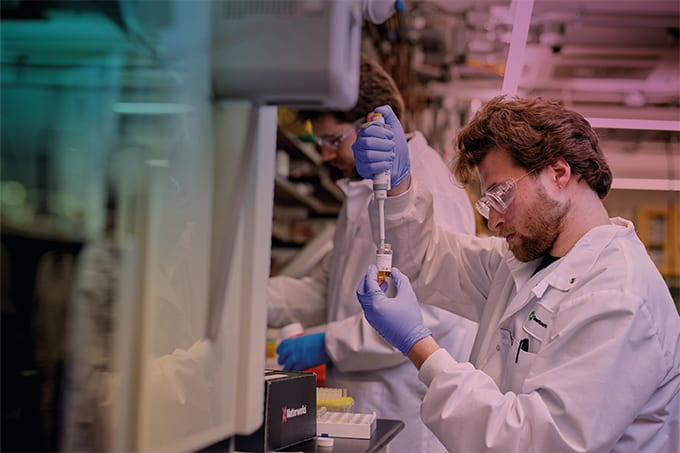
Credit: Dr. Masakazu Umezawa from Tokyo University of Science, Japan

“The issue of MPs has been raised worldwide, and there are several news articles on the web, but the topic of how they move inside the body has not been discussed, and there remain many unclear aspects,” said study lead Masakazu Umezawa in a press release

. “I wanted to contribute by proposing a new method to clarify this issue.”

To create more realistic model particles, plastic granules were fragmented in solvent to generate irregular nanoscale fragments before incorporating the near-infrared dye IR-1061. For polymers such as PP, PE, and PS that resist dye uptake, gentle heating to 55 °C expanded the polymer chains and allowed the dye to diffuse into the material. The addition of bovine serum albumin prevented particle aggregation, producing water-dispersible microplastics with stable fluorescence.

In mouse experiments, deep-tissue imaging showed that orally administered particles remained in the stomach for several hours before moving into the intestines and eventually being excreted. No fluorescence was detected in tissues outside the gastrointestinal tract, suggesting minimal absorption beyond the digestive system. Particle size also influenced intestinal retention, with smaller particles remaining longer in the gut.

The researchers also demonstrated that the particles could be loaded with other dyes, including Nile red, enabling studies of cellular uptake in vitro.

“The development of methods for synthesizing NIR-II-fluorophore-loaded microplastic models with various chemical compositions will support risk assessments by providing insights into the environmental and biological fate of MPs,” Umezawa said.

According to the researchers, such fluorescent microplastic models could help clarify how environmental particles behave in biological systems and support future studies assessing their potential health effects.

Newsletters

Receive the latest analytical science news, personalities, education, and career development – weekly to your inbox.

Newsletter Signup Image

False

Advertisement

Recommended

False

Related Content

The Analytical Scientist Innovation Awards 2024: #5
Translational Science
The Analytical Scientist Innovation Awards 2024: #5

December 4, 2024

4 min read

Welcome to the 5th ranked Innovation, Pyxis – introduced here by Matterworks co-founder Jack Geremia

The Analytical Scientist Innovation Awards 2024: #4
Translational Science
The Analytical Scientist Innovation Awards 2024: #4

December 5, 2024

6 min read

Thermo Fisher Scientific’s high-sensitivity mass spec for translational omics research – the Stellar MS – is ranked 4th in our annual Innovation Awards

The Analytical Scientist Innovation Awards 2024: #3
Translational Science
The Analytical Scientist Innovation Awards 2024: #3

December 6, 2024

4 min read

Bruker’s multiphoton microscopy module, OptoVolt, ranks third in our Innovation Awards. Here, Jimmy Fong, product development lead, walks us through the major moments during development.

Spit It Out
Translational Science
Spit It Out

December 4, 2024

1 min read

Saliva-based PA-MS test detects paracetamol overdose in just 10 minutes

False

The Analytical Scientist
Subscribe

About

  • About Us
  • Work at Conexiant Europe
  • Terms and Conditions
  • Privacy Policy
  • Advertise With Us
  • Contact Us

Copyright © 2026 Texere Publishing Limited (trading as Conexiant), with registered number 08113419 whose registered office is at Booths No. 1, Booths Park, Chelford Road, Knutsford, England, WA16 8GS.